There Is No Single Right Way—But Some Ways Are Better
The 8x10 rug is versatile enough to work in several living room configurations, but the wrong placement makes even a beautiful rug look awkward. This guide covers every common living room layout and explains exactly how an 8x10 should be positioned in each one.
Layout 1: Sofa Against the Wall
This is the most common arrangement in smaller living rooms and the one where placement decisions are most consequential.
Correct approach: Pull the sofa 6–12 inches off the wall. Place the 8x10 so the front legs of the sofa rest on the rug, with the rug extending forward under the coffee table and toward the TV console or opposite seating. The rug should not be pushed all the way under the sofa—having just the front two legs on the rug visually connects the sofa to the rug without requiring the rug to extend behind it.
Common mistake: Pushing the rug all the way against the wall under the sofa. This puts most of the rug under furniture, wastes the rug's visual impact, and makes the coffee table area feel disconnected.
Layout 2: Floating Sofa (Sofa in the Middle of the Room)
A sofa floated in the center of a room creates a more formal, balanced arrangement and is increasingly common in larger open-plan spaces.
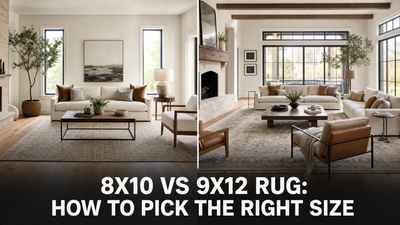
Correct approach: Center the 8x10 rug under the seating arrangement. The rug should extend at least 12–18 inches past the front of the sofa toward the coffee table and television, and 6–12 inches past the sides of the sofa arrangement. The sofa's front and back legs can both rest on the rug if the furniture grouping fits within the 8-foot width.
Visual effect: A floating sofa over a centered rug creates a defined "room within a room"—particularly effective in open-plan spaces where the living area would otherwise blur into the dining or kitchen zone.
Layout 3: Sectional Sofa
Sectionals present the biggest challenge for 8x10 rugs because most L-shape sectionals are wider than 8 feet on at least one side.
Correct approach: Place the 8x10 so the chaise or longer arm of the sectional has its front legs on the rug, with the rug extending toward the interior corner of the L-shape. The goal is to have the rug cover the primary traffic and coffee table zone—not to extend under the full sectional.
When 8x10 doesn't work with a sectional: If your sectional is 110 inches or wider and you want the rug to feel proportional, a 9x12 is the better choice. A visually undersized rug under a large sectional is one of the most common decorating problems in living rooms.
Layout 4: Open-Plan Zoning
In an open-plan living/dining space, the 8x10 rug defines the living area boundary. This is its most important job in an open floor plan—without it, the sofa and chairs feel like they're floating in a combined space with no organization.
Correct approach: Place the rug so it covers the seating area entirely, with furniture legs resting on the rug. The edge of the rug serves as the visual boundary between living and dining zones. Leave at least 24 inches of bare floor between the rug edge and the dining area rug (if there is one).
Tip: In open-plan layouts, the 8x10 rug doesn't need to be centered in the room—it needs to be centered on the furniture grouping. These are two different things, and confusing them leads to off-balance arrangements.
Centering: Room vs. Furniture
One of the most common placement errors: centering the rug on the room rather than on the furniture grouping. In a symmetrical room with centered furniture, these are the same thing. But in a room where the sofa is positioned to one side, or where a doorway or fireplace disrupts the layout, centering on the furniture produces a better result than centering on the floor.
The "Float" Test
Once you've placed your 8x10 rug, step back and check: does the rug look like it belongs to the furniture, or does it look like it's sitting on the floor near the furniture? The rug should feel visually attached to the furniture grouping—like a platform the furniture rests on. If it looks loose or disconnected, adjust the position so more furniture makes contact with the rug surface.
Related Articles
- 8x10 Rug: The Most Popular Size Explained
- Best 8x10 Rug Styles for High-Traffic Living Rooms
- Layering a 2x3 Rug Over a Larger One
About RugKnots
RugKnots is a family-owned rug company based in Hagerstown, Maryland. Founded in 2010, we've spent over 14 years helping homeowners and designers find the right rug — from hand-knotted Persian heirlooms to durable machine-made everyday pieces. We hand-inspect every order before it ships, offer free U.S. shipping, and back every purchase with our 30-day return guarantee.
This article was written by our editorial team and reviewed for accuracy. Our writers work directly with our buyers and customer-experience team, who handle thousands of rug questions every year. If you have a question this article didn't answer, reach out — a real human will get back to you within one business day.