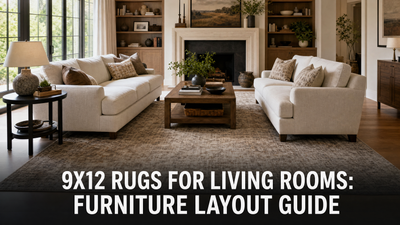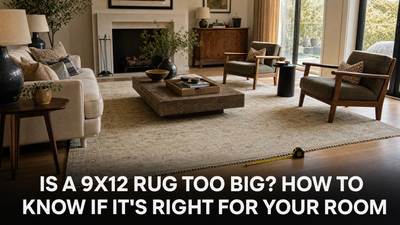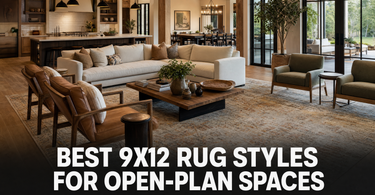
Open-plan living spaces are wonderful until you realize they're a single large room with no natural boundaries. A 9x12 rug is one of the most effective tools for creating definition — it turns one big space into multiple functional zones without building walls. But placement and style choices determine whether it works or creates visual chaos.
How a Rug Creates a Zone
In an open plan, a rug creates a zone through visual containment — it gives the seating group (or dining group) a defined platform that reads as distinct from the surrounding floor. The effect is psychological but strong: people naturally understand that the furniture on the rug belongs together and that the area around it is passage space.
For this to work, the rug needs to be appropriately large. An undersized rug in an open plan floats and looks tentative — it doesn't convincingly contain the furniture group. A 9x12 is typically the minimum useful size for defining a living area in an open-plan space of 600+ square feet. In very large open plans, two separate rugs defining two separate zones is often better than one oversized rug trying to do everything.
Zone Placement Strategy
In a typical open-plan kitchen-dining-living layout:
- The 9x12 goes under the living room seating group. Position it so the living area reads as separate from the dining area — typically with at least 3–4 feet of bare floor between the edge of the living rug and the dining chairs.
- The dining area may not need a rug at all, or uses a smaller separate rug. Two large rugs butting up against each other in an open plan create confusion rather than definition.
- The kitchen has no rug, or a small washable runner at the sink — keeping the kitchen zone distinct from the living and dining areas.
Pattern Scale in Open-Plan Spaces
Scale of pattern relative to room size is one of the most commonly misunderstood principles in rug selection.
In a large open plan, a rug with a small, tight repeat pattern — small diamonds, small geometric tile — will look busy and scattered from a standing distance. The pattern doesn't read as a pattern; it reads as texture. This isn't necessarily wrong, but if you want the rug's design to be appreciated, you need a repeat size that registers at 10–15 feet viewing distance.
General guidance for a 9x12 in an open plan:
- Medallion designs: The central medallion should be at least 24–36 inches in diameter to register as a feature in a large room. Small medallions look proportional in a bedroom; in an open plan, they look like a texture.
- Geometric patterns: Large-scale geometric repeats (18+ inch grid or diamond) work well in open plans. They provide visual structure without complexity.
- Organic or abstract patterns: These are scale-flexible — an organic watercolor-style pattern reads as texture from far away and as pattern from close, which works in open plans where the rug will be seen from multiple distances.
Color in Open-Plan Spaces
In a closed room, the rug's color only needs to coordinate with that room's contents. In an open plan, the rug is visible from the kitchen, the dining area, the entryway, and often the hallway. Its color needs to work with a wider range of elements.
Strategies that tend to work:
- Warm neutrals (ivory, warm gray, sand, taupe): Easy to coordinate across multiple areas. Don't compete with adjacent spaces. Work with most furniture finishes.
- One strong accent color in a pattern: If the rug has a terracotta, navy, or sage accent color, you can thread that color through the living area in pillows and throws without it clashing with the dining area 12 feet away.
- Avoid very saturated, all-over color: A strongly colored solid rug (deep red, royal blue) in an open plan creates a heavy color statement visible from everywhere in the space — it dominates rather than defines.
Style Recommendations for Open Plans
Modern and Contemporary Open Plans
Flat-weave or low-pile rugs in large-scale geometric patterns — herringbone, large diamond, abstract stripe — work well. They're clean and graphic without adding the visual weight of a thick pile rug. Neutral palettes with one accent color keep the look cohesive.
Transitional Open Plans
A 9x12 in a traditional Persian-inspired design (Heriz-style geometric, Oushak soft medallion) works well in transitional spaces because the classic pattern reads as intentional against contemporary furniture. The key is choosing a washed or muted palette rather than strong primary colors.
Bohemian or Eclectic Open Plans
A large vintage-style rug or an oversized Moroccan-inspired design works here. The visual energy of the rug is balanced by the intentional eclecticism of the surrounding space. Let the rug be bold, but keep adjacent textiles (sofa, curtains) quieter.
Practical Consideration: Rug Pad in Open Plans
In an open-plan space where people move between zones frequently, a rug that shifts or bunches is a trip hazard and looks immediately unkempt. A high-quality rug pad is more important here than in a closed room — use a pad specifically rated for hard flooring (not carpet-over-carpet pads), cut to 1 inch smaller than the rug on all sides.
Related Articles
- Is a 9x12 Rug Too Big? How to Know If It's Right for Your Room
- 9x12 Rugs for Living Rooms: Furniture Layout Guide
- Vintage Rugs in Modern Homes: How to Style Them Without It Looking Dated
Related Buying Guides
About RugKnots
RugKnots is a family-owned rug company based in Hagerstown, Maryland. Founded in 2010, we've spent over 14 years helping homeowners and designers find the right rug — from hand-knotted Persian heirlooms to durable machine-made everyday pieces. We hand-inspect every order before it ships, offer free U.S. shipping, and back every purchase with our 30-day return guarantee.
This article was written by our editorial team and reviewed for accuracy. Our writers work directly with our buyers and customer-experience team, who handle thousands of rug questions every year. If you have a question this article didn't answer, reach out — a real human will get back to you within one business day.