Both octagon and round rugs depart from the rectangular default—but they're not interchangeable. The differences in how they interact with furniture and architecture are real and worth understanding before you buy.
The Visual Difference
A round rug is an unbroken circle—fluid, soft, and directionally neutral. It has no "front" or "back," no corners, and no linear reference points. It reads as organic and relaxed.
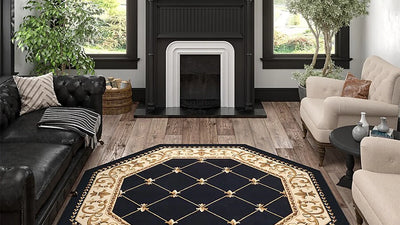
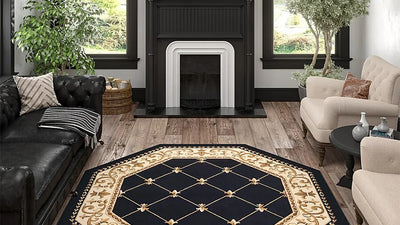
An octagon rug, while similar from a distance, has defined corner cuts that give it a slight geometric formality. The flattened sides create subtle directional references that align more naturally with architectural square rooms. It's softer than a square rug but more structured than a round one.
Furniture Pairing Differences
Round Rugs Pair Best With:
- Round dining tables (the shapes are obviously complementary)
- Curved sofas or chairs—round rugs and rounded furniture share a design vocabulary
- Small accent groupings: two chairs facing each other over a small round rug, with a side table between them
- Children's rooms and playrooms, where the soft shape and absence of corners creates a welcoming zone
Octagon Rugs Pair Best With:
- Square rooms—the octagon acknowledges the room's geometry while softening it
- Square or round dining tables—the octagon complements both
- Formal or traditional furniture arrangements—the octagon has slightly more gravitas than a round rug
- Entry halls with a central fixture, where the corners provide subtle alignment references
Which Rooms Suit Each
Round Rugs Excel In:
- Dining rooms with round tables
- Small living room accent zones
- Nurseries and children's rooms
- Bohemian or eclectic spaces where the organic shape fits the looser aesthetic
- Breakfast nooks
Octagon Rugs Excel In:
- Formal entry halls
- Dining rooms with square or round tables
- Bedroom sitting areas
- Traditional or transitional rooms where the slightly geometric form feels at home
The Pattern Question
Pattern plays out differently on each shape. A medallion rug—with its central circular composition—is equally suited to both round and octagon formats. The medallion's circular center harmonizes with a round rug naturally; on an octagon, the corners frame the central composition in a slightly more formal way that many find very appealing.
Geometric or tribal patterns work better on octagon rugs than on round ones, because the octagon's subtle angles provide alignment context for the angular motifs. Flowing, organic patterns (large-scale floral, abstract) work equally well on both.
Sizing Comparison
Octagon rugs are typically described by their widest diameter (the distance across the longest dimension). A 6-foot octagon rug covers roughly the same floor area as a 6-foot round rug, but the corner cuts mean it visually "reads" as slightly smaller than the diameter suggests. Round rugs cover floor area more efficiently relative to their described size.
The Bottom Line
- Choose round if: you have curved furniture, a round dining table, or want maximum softness and fluidity
- Choose octagon if: you have a square room, want a slight geometric formality, or specifically want an entry rug that feels more structured than a circle