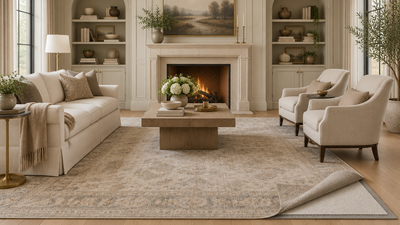
White walls are the most common backdrop in modern homes — and for good reason. They're flexible, they make rooms feel larger, and they let your furniture and rugs do the talking. But that flexibility cuts both ways: because white walls don't compete with anything, a rug that's slightly off will be immediately obvious.
The good news is that white walls pair well with a wider range of rug colors than almost any other wall color. Here's how to make the most of that flexibility.
Warm White vs Cool White: It Matters More Than You Think
Not all white walls are the same. Before choosing a rug color, identify whether your white has warm or cool undertones.
- Warm white walls (cream, off-white, antique white — paints like Benjamin Moore White Dove or Sherwin-Williams Alabaster) have yellow, pink, or beige undertones. They work best with warm-toned rugs: terracotta, rust, camel, warm gray, olive, and ivory.
- Cool white walls (pure white, bright white — like Chantilly Lace or Pure White) have blue or gray undertones. They pair better with cool-toned rugs: navy, slate blue, charcoal, sage green, and crisp neutrals.
Putting a warm rug against cool white walls creates a subtle clash — both elements feel slightly "off" without the viewer being able to pinpoint why. Matching undertones is the easiest way to make a room feel cohesive without consciously designing it.
The Contrast Play: Bold Rugs Against White Walls
White walls are the ideal backdrop for a statement rug precisely because they don't compete. A deeply saturated rug color reads with maximum impact against white.
Color Combinations That Work
- Navy + white walls: Classic, graphic, and endlessly versatile. A navy Oriental or geometric rug grounds a room with white walls without darkening the space.
- Rust or terracotta + white walls: Warm and earthy against clean white — popular in bohemian and transitional spaces. Works especially well with warm white walls.
- Forest or sage green + white walls: Fresh and botanical. Deeper greens (hunter, forest) feel more traditional; lighter greens (sage, eucalyptus) feel more contemporary.
- Deep burgundy or wine + white walls: Rich and dramatic. Works in traditional or eclectic spaces with wood furniture and brass accents.
- Charcoal or graphite + white walls: High-contrast and modern. Best in spaces with clean lines and minimal furniture.
The Tone-on-Tone Play: Quiet, Layered Looks
Not every room needs drama. If you want a calm, cohesive space, matching your rug closely to your wall color creates a layered, tonal look that feels intentional and sophisticated.
- Ivory or cream rugs against warm white walls add texture without contrast — works beautifully with natural materials like linen, rattan, and wood
- Natural fiber rugs (jute, sisal, seagrass) pair exceptionally well with white walls — the raw texture creates visual interest without color competition
- Light gray rugs against cool white walls create a quiet, Scandinavian-inspired palette
The key to making tone-on-tone work is texture. Without contrast in color, the rug needs to have enough tactile or visual texture — a high-low pile, a flatweave pattern, or a natural woven surface — to register as its own distinct element in the room.
What to Avoid
- Rugs with lots of white or very light cream: Against white walls, a predominantly white rug disappears. The rug loses its ability to anchor the room and the whole space can feel washed out.
- Mismatched undertones: A warm rust rug against a stark cool-white wall, or a cool blue-gray rug against a creamy warm-white wall, creates subtle but persistent visual tension.
- Very light, low-contrast patterns: White walls already provide a clean backdrop — a rug with a barely-visible tone-on-tone pattern in light colors won't register at all. Either go bolder in color or choose a rug with clear texture.
Pattern Guidance: White Walls Can Handle Bold
One of the best things about white walls is that they let patterns breathe. A bold geometric rug, a large-scale medallion Persian, or a high-contrast kilim reads clearly against white because there's no competing visual noise from the walls.
This means white-walled rooms are ideal for:
- Large-scale Oriental patterns in navy, red, and ivory
- Bold Moroccan or trellis geometrics
- Abstract contemporary rugs in saturated colors
- High-contrast flatweave kilims
If your furniture is already patterned (plaid sofa, floral pillows, graphic curtains), stick with a solid or low-key geometric rug to avoid pattern overload. White walls give you a pass — but the furniture doesn't.
Quick Reference: Specific Pairings That Work
- Navy rug + white walls + natural wood furniture = timeless
- Terracotta rug + warm white walls + rattan + linen = warm bohemian
- Sage green rug + white walls + white oak furniture = fresh contemporary
- Charcoal geometric rug + cool white walls + black metal frames = modern industrial
- Ivory wool rug + warm white walls + aged brass = quiet luxury
- Rust tribal rug + white walls + leather sofa = eclectic traditional
At RugKnots, you can filter rugs by color to find the exact tone you're looking for — and every rug comes with a free return policy so you can test it in your space before committing.
Related Articles
- How to Choose a Rug Color: A Room-by-Room Guide
- Best Neutral Rugs: When to Go Beige, Gray, or Cream
- How to Mix Patterns in a Room Without It Looking Busy
About RugKnots
RugKnots is a family-owned rug company based in Hagerstown, Maryland. Founded in 2010, we've spent over 14 years helping homeowners and designers find the right rug — from hand-knotted Persian heirlooms to durable machine-made everyday pieces. We hand-inspect every order before it ships, offer free U.S. shipping, and back every purchase with our 30-day return guarantee.
This article was written by our editorial team and reviewed for accuracy. Our writers work directly with our buyers and customer-experience team, who handle thousands of rug questions every year. If you have a question this article didn't answer, reach out — a real human will get back to you within one business day.