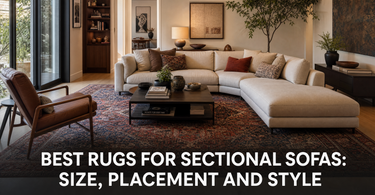
Sectional sofas are one of the trickiest pieces of furniture to pair with a rug. They're large, asymmetrical, and they don't follow the same placement rules as a standard sofa. Here's how to get it right without second-guessing yourself.
Why Sectionals Are Different
A standard sofa and two chairs create a U-shaped or symmetrical conversation area that's easy to anchor with a rectangular rug. A sectional—especially an L-shape—extends further in one direction and leaves one corner anchored and one end floating. You need a rug that's large enough to contain the whole sectional, not just the longest side.
Sizing: Start Here
The most common mistake with sectional rugs is buying too small. If even one piece of your sectional has no legs on the rug, the furniture looks disconnected from the space.
The 9x12 — Most Common Sectional Rug Size
A 9x12 works for most mid-size L-shaped sectionals in a standard living room. It's large enough to anchor a sectional with 5–6 seats and a coffee table, with all front legs (at minimum) on the rug. A 9x12 also works in a 12'x15' or 12'x16' living room—it fills the space intentionally without crowding the walls.
The 10x14 — For Larger Sectionals and Open Plans
If your sectional is a large U-shape, a double chaise, or seats 7+, a 10x14 is more appropriate. This size also works when the living room opens into a dining area and you want the rug to define the seating zone without being swallowed by the overall square footage. In an open-plan space of 20'x20' or larger, a 9x12 will look too small—go 10x14.
Measuring Your Sectional for a Rug
- Arrange your sectional exactly where you want it.
- Measure the full width of the longer section (typically the sofa portion of an L-shape).
- Measure the depth from the back of the sectional to the front of where the coffee table will sit, plus 12–18 inches.
- The rug dimensions should meet or exceed both measurements.
L-Shape Placement: The Two Approaches
Option 1: Rug Under the Long Arm
Position the rug to run parallel to and under the longer arm of the L. The short arm of the sectional will have front legs on the rug or float just off it. This works best when the living room is rectangular and the L-shape sits against two walls.
Option 2: Rug Centered on the Conversation Area
Center the rug on the coffee table and the interior of the L, so the rug sits inside the sectional's footprint rather than under it. All three sides of the interior see the rug. This is the most visually cohesive approach for open L-shapes where both arms are roughly equal in length.
Either approach works—the key is that the coffee table sits entirely on the rug in both cases. The coffee table anchors the rug visually, so it must be fully on the rug or the arrangement looks incomplete.
Color Matching With a Sectional
When the Sectional Is Neutral
Gray, beige, and white sectionals are common precisely because they're easy to style. With a neutral sectional, the rug can carry pattern and color. A geometric, Persian-inspired, or tribal print in 2–3 colors adds visual interest without competing with the furniture. Choose one color in the rug that matches or coordinates with an accent color in the room—a throw pillow, artwork, or curtain.
When the Sectional Has Color
A blue, green, or earth-toned sectional needs a rug that doesn't fight it. Options:
- A neutral rug (ivory, oatmeal, greige) in a subtle texture like a flatweave or low-pile wool
- A rug that picks up one tone from the sectional—not a match, but a complement. A slate blue sectional with a rug in warm navy or dusty teal reads as intentional.
- A patterned rug that includes the sectional's color as one of several colors—this unifies the room without being matchy
Pattern Scale
Large sectionals need rugs with appropriately scaled patterns. A small all-over pattern on a 10x14 rug can look visually busy and indistinct from a distance. Larger geometric repeats, bolder stripes, or medallion patterns in a large scale work better with a sectional than small-scale all-over patterns.
Pile Height for Sectional Rugs
- Under 0.5": Easy to push furniture around on, no furniture leg dents. Best for households with pets or where furniture gets rearranged.
- 0.5"–1": The most common pile height for living room rugs. Comfortable underfoot, good texture. Furniture legs may leave impressions over time.
- Over 1" (high pile/shag): Luxurious but harder to vacuum, shows furniture tracks, and can cause sectional legs to sink unevenly. Not ideal unless you're willing to rotate and maintain the rug consistently.
Related Articles
- Persian Rug vs Oriental Rug: What's Actually the Difference?
- How to Layer Rugs in an Entryway
- Outdoor Rug Sizing Guide for Patios and Decks
About RugKnots
RugKnots is a family-owned rug company based in Hagerstown, Maryland. Founded in 2010, we've spent over 14 years helping homeowners and designers find the right rug — from hand-knotted Persian heirlooms to durable machine-made everyday pieces. We hand-inspect every order before it ships, offer free U.S. shipping, and back every purchase with our 30-day return guarantee.
This article was written by our editorial team and reviewed for accuracy. Our writers work directly with our buyers and customer-experience team, who handle thousands of rug questions every year. If you have a question this article didn't answer, reach out — a real human will get back to you within one business day.