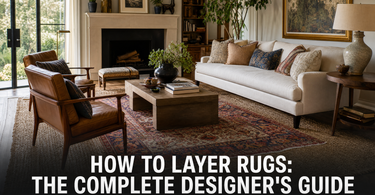
Rug layering has moved from a bohemian styling trick to a mainstream design technique used by interior designers in everything from farmhouse living rooms to modern apartments. Done right, it adds depth, warmth, and a collected-over-time character that a single rug can't achieve. Done wrong, it looks like you couldn't decide which rug you wanted and compromised.
This guide covers the rules — when to layer, which rugs to use as the base versus the top layer, how to mix patterns, and specific room setups that work.
Why Layer Rugs?
- Add size coverage inexpensively: A large base rug in a neutral natural fiber (jute, sisal, seagrass) is relatively affordable. Layering a smaller, more interesting rug on top gives you the coverage of the large rug and the design interest of the smaller one — often cheaper than one large patterned rug.
- Create visual depth: Two rugs have more visual dimension than one — the texture and edge contrast creates a layered, rich effect that reads as curated rather than catalog.
- Zone a space within a space: In an open-plan room or large living area, layering a smaller rug on a larger base creates a defined inner zone within the larger area.
- Protect a valuable rug: Layering a less expensive rug over a valuable antique or hand-knotted piece in high-traffic zones protects the investment piece while still showing off its edges and borders.
The Base Rug: What to Use
The base rug should be:
- Larger than the top rug — at least 2 feet larger in each dimension, ideally 3–4 feet
- Neutral in color and pattern — so it doesn't compete with the top rug
- Flat in texture — so the top rug lies stable and doesn't shift
- Lower in price — since much of it will be covered
Best Base Rug Options
- Jute or sisal: The most popular base rug choice. Neutral straw-gold tone, organic texture, flat weave that provides a stable platform for the top rug. A 9x12 jute base rug costs a fraction of a 9x12 wool pile rug.
- Seagrass: Similar to jute but slightly more durable and moisture-resistant.
- Solid neutral cotton flatweave: A solid ivory, cream, or soft gray cotton dhurrie works as a base — it's a soft, thin platform that doesn't compete with the top rug.
- Simple solid polypropylene: A solid gray or ivory machine-made rug at low pile works as a budget-friendly base for occasional or seasonal layering.
The Top Rug: What to Use
The top rug is where the design lives. It should be:
- Smaller — ideally positioned so 12–18 inches of the base rug shows on all sides
- More interesting — bolder pattern, richer texture, or more decorative design
- Anchored to furniture — position the top rug so furniture legs sit on it, connecting it to the room rather than leaving it floating on the base
Best Top Rug Options
- Persian / Traditional pattern: A Persian medallion or geometric rug on a jute base is the most classic layered look — the organic texture of the jute contrasts with the intricate pattern of the Persian.
- Kilim flatweave: A bold Kilim on a neutral base adds graphic color and global character.
- Vintage or distressed: A faded vintage rug layered on a neutral base has the "collected over time" feel that's very popular in bohemian and modern farmhouse interiors.
- Faux sheepskin or cowhide: Layering a hide or sheepskin over a flat rug adds extreme textural contrast — very effective in modern and eclectic spaces.
Sizing the Layer
The most common layering mistake: the top rug is too large relative to the base, leaving almost no base rug visible. The base needs to show — otherwise it's just a rug hidden under another rug.
Standard proportions:
- Base rug 9x12 + top rug 5x8 (shows 2 feet of base on each side of the top's long dimension, 2 feet on each short side) ✅
- Base rug 8x10 + top rug 5x8 (top rug nearly fills the base — too large) ✗
- Base rug 9x12 + top rug 6x9 (shows 18 inches on long sides, 18 inches on short sides) ✅
Offsetting vs. Centering the Top Rug
Most layered rug setups center the top rug on the base — which looks intentional and orderly. However, deliberately offsetting the top rug (shifting it toward one end of the base, or toward one side) creates a more casual, collected look that works in bohemian and eclectic spaces. Both are valid — the choice depends on the room's overall aesthetic.
Pattern Mixing Rules
Layering two patterned rugs is advanced territory. The rules:
- Different scales: A large-scale geometric base + a small-scale Persian top ✅. Two rugs with the same scale pattern fight each other ✗.
- Coordinated palette: The two rugs should share at least 2 colors. They don't need to match — they need to be from the same family.
- One geometric + one organic: A geometric base + a floral or organic top creates visual contrast without conflict.
- Flat + pile: Mixing textures (flatweave base + pile top, or jute base + shag accent) almost always works — the textural contrast is inherently interesting.
Room-by-Room Layering
Living Room
The most common setup: 9x12 jute base, 6x9 vintage Persian or kilim on top, furniture front legs on the top rug. The base extends beyond the furniture grouping on all sides; the top rug defines the central conversation zone.
Bedroom
Layer a 5x8 flatweave under an 8x10 on the side of the bed — the flatweave base shows 2 feet on the sides not covered by the pile rug. Alternatively, layer a small Moroccan or geometric top rug at the foot of the bed on a larger neutral base that runs under the bed.
Bohemian Living Room
Multiple small rugs — kilims, vintage Persians, flatweave fragments — layered and overlapping on a large neutral base. No strict centering, deliberate offset and overlap. The chaos is the aesthetic. This works because all the rugs are in a coordinated earth-tone palette.
Keeping the Top Rug in Place
A rug on top of a rug on a floor has three surfaces to manage: floor → bottom pad → base rug → top rug. The top rug will shift if not secured:
- Rug-on-rug pad: A thin, grippy pad cut to the top rug's size placed between the base and top rug. Very effective.
- Rug corner clips: Metal clips that grip both rugs together at the corners. Invisible and very secure.
- Furniture weight: If all four legs of your furniture sit on the top rug, it won't move significantly — the weight anchors it.
Shop Layering-Ready Rugs at RugKnots
RugKnots carries rugs perfect for both roles in a layered setup — from affordable neutral jute bases to statement-worthy hand-knotted top rugs.
- 9x12 rugs — ideal large base size →
- 5x8 rugs — ideal top layer size →
- Vintage rugs — perfect top layer character →
- Traditional Persian — classic layering top rug →
About RugKnots
RugKnots is a family-owned rug company based in Hagerstown, Maryland. Founded in 2010, we've spent over 14 years helping homeowners and designers find the right rug — from hand-knotted Persian heirlooms to durable machine-made everyday pieces. We hand-inspect every order before it ships, offer free U.S. shipping, and back every purchase with our 30-day return guarantee.
This article was written by our editorial team and reviewed for accuracy. Our writers work directly with our buyers and customer-experience team, who handle thousands of rug questions every year. If you have a question this article didn't answer, reach out — a real human will get back to you within one business day.