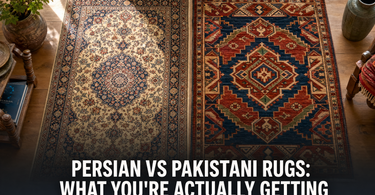
Walk into any rug store and you'll see the labels: "Persian rug," "Pakistani rug," "Afghan rug." The prices vary considerably. The designs often look similar. And unless you know what to look for, it's hard to understand why one costs twice as much as another that looks nearly identical from across the room.
This guide cuts through the marketing and gives you a straight comparison of Persian and Pakistani rugs — the two most common hand-knotted rug categories on the US market — so you can make an informed buying decision.
The Short Answer
Persian rugs are made in Iran (Persia) and carry the weight of the world's oldest continuous rug-making tradition — some city workshops have been producing the same designs for 400+ years. Pakistani rugs (particularly Peshawar and Lahore rugs) are made using largely the same techniques and many of the same design traditions, but with Pakistani wool and Pakistani labor.
Neither is universally superior. The right choice depends on what you're optimizing for.
Origin and Tradition
Persian Rugs
Iran has been producing hand-knotted rugs for at least 2,500 years. The major weaving cities — Tabriz, Isfahan, Kashan, Heriz, Kerman, Qom — each developed distinct design traditions, knotting styles, and material standards that remain identifiable today. A Tabriz rug has specific characteristics (typically Persian knots, fine wool or silk, highly detailed curvilinear patterns) that distinguish it from a Heriz (Turkish knot, coarser pile, bold geometric patterns) or a Kashan (high knot density, traditional floral medallion, high-quality wool).
This geographic and workshop specificity means "Persian rug" is not a monolithic category — it spans an enormous range of quality, from tourist-grade machine-assisted work to workshop masterpieces that take 3–4 years to complete.
Pakistani Rugs
Pakistan's rug industry developed significantly in the 20th century, partly driven by the migration of Afghan weavers during regional conflicts and the establishment of large workshop cities in Lahore, Peshawar, Karachi, and Rawalpindi. Pakistani weavers use designs borrowed directly from Persian, Afghan, and Caucasian traditions — you'll find Heriz-style geometrics, Kashan-style medallions, and Tabriz-inspired scrolling borders all produced in Pakistani workshops.
The most respected Pakistani rugs are the Peshawar (Chobi) rugs — hand-knotted, typically with natural vegetable dyes, Afghan Ghazni wool, and designs descended from the Ziegler & Co. commercial Persian rug tradition of the 19th century. These are genuinely excellent rugs.
Wool Quality
This is where the most meaningful differences exist.
Iranian Wool
The best Iranian rugs use wool from specific regions — Khorasan, Kurdistan, Azerbaijan — where sheep are raised at elevation and the cold climate produces long-staple, resilient fiber. Kurk wool (from the neck and underbelly of sheep) is the finest grade, used in the best Kashan and Isfahan rugs. Merino-grade Iranian wools are among the finest natural textile fibers in the world.
However: not all Persian rugs use premium wool. Workshop rugs from less prestigious regions use standard quality wool. The origin label "Persian" doesn't guarantee superior wool — it guarantees Iranian origin, which correlates with quality tradition but doesn't automatically deliver it.
Pakistani / Afghan Ghazni Wool
The Ghazni province of Afghanistan produces wool that many experts consider the benchmark for hand-knotted rug production. Ghazni sheep are raised at 7,000+ feet, producing dense, long-staple fiber with excellent natural luster. Peshawar rugs that use Ghazni wool are working with one of the world's finest rug fibers.
Lower-grade Pakistani rugs use domestic Pakistani wool that is shorter-staple and less resilient — the difference is significant in long-term durability.
Knotting and Construction
Knot Types
- Persian knot (Senneh knot): Asymmetric, can be tied to either side. Used in most Iranian workshops and many Pakistani workshops. Allows for more curved, detailed designs.
- Turkish knot (Ghiordes knot): Symmetric, tied around two warp threads. More commonly used in tribal and village rugs, northwestern Iran, and Turkish production. Creates a stronger pile but slightly less design detail capability.
Pakistani Peshawar rugs typically use Persian knots. The knot type is less important than knot density and wool quality in determining real-world performance.
Knot Density
Knot density (KPSI — knots per square inch) determines pattern detail and structural durability. Both Persian and Pakistani rugs span a wide range:
- Village/tribal Persian: 40–80 KPSI
- City Persian (Tabriz, Heriz): 60–150 KPSI
- Fine Persian (Kashan, Isfahan, Qom): 100–400+ KPSI
- Peshawar/Chobi Pakistani: 60–100 KPSI
- Lahore Pakistani: 80–150 KPSI
Design
Persian rugs from specific cities carry design vocabularies that are unique and centuries-old. A Heriz design was developed in Heriz. A Kashan design evolved in Kashan workshops. These are regionally authentic.
Pakistani rugs often reproduce Persian designs — sometimes very faithfully, sometimes loosely adapted. A Peshawar "Ziegler" rug uses a design tradition that originated with European commercial commissions in 19th-century Iran but is now primarily produced in Pakistan. The design is borrowed but the execution is authentic and high-quality.
For most buyers, the design distinction matters less than whether the rug looks beautiful in their room. Pakistani rugs reproducing Persian designs can be visually indistinguishable from their Iranian counterparts to all but expert eyes.
Price
Iranian rugs carry a premium — partly justified by the finest wool grades and highest knot counts in the market, partly by the origin prestige and collector demand. A comparable-quality Pakistani rug typically costs 20–40% less than its Iranian counterpart for the same size and design quality.
For buyers prioritizing aesthetics and durability over provenance: a quality Peshawar or Lahore rug often represents better value than a mid-grade Iranian rug at the same price point.
Which Should You Buy?
| Priority | Choose |
|---|---|
| Authentic Iranian origin / collectability | Persian |
| Best value for the quality level | Pakistani (Peshawar/Chobi) |
| Natural dyes and muted palette | Peshawar (leaders in natural dye use) |
| Ultra-fine detail, high KPSI | Persian (Kashan, Isfahan, Qom) |
| Tribal/geometric character | Afghan or tribal Persian — similar quality at similar price |
| Budget under $1,000 for a 5x8 | Pakistani or Afghan hand-knotted |
The honest answer: For most residential buyers, a quality Pakistani Peshawar rug with Ghazni wool and natural dyes will serve as well as, and sometimes better than, a comparably priced Persian rug. The prestige gap is real. The performance gap is smaller than the price gap suggests.
Browse hand-knotted Persian and Pakistani rugs at RugKnots →
How to buy a real Persian rug online without getting scammed →
About RugKnots
RugKnots is a family-owned rug company based in Hagerstown, Maryland. Founded in 2010, we've spent over 14 years helping homeowners and designers find the right rug — from hand-knotted Persian heirlooms to durable machine-made everyday pieces. We hand-inspect every order before it ships, offer free U.S. shipping, and back every purchase with our 30-day return guarantee.
This article was written by our editorial team and reviewed for accuracy. Our writers work directly with our buyers and customer-experience team, who handle thousands of rug questions every year. If you have a question this article didn't answer, reach out — a real human will get back to you within one business day.