


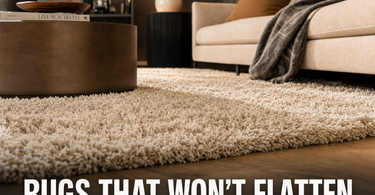
There is nothing more frustrating than spending hundreds of dollars on a thick, plush, luxurious rug, only to watch it turn into a matted, flattened pancake within six months. You try vacuuming it, you try fluffing it with your hands, but the dreaded "traffic lanes" where people walk remain permanently crushed.
Rug flattening is not just a sign of heavy use; it is a sign of poor material choice. Some fibers have a natural "memory" and will bounce back after being stepped on, while others simply crush under pressure and never recover. If you want a rug that won't flatten, here is exactly what you need to buy (and what you must avoid).
Table of Contents
The Science of Rug Crushing
When you step on a rug, you apply hundreds of pounds of pressure per square inch onto the fibers. Over time, the structural integrity of the yarn breaks down. If the yarn is made of a weak material, it bends at the base and stays bent.
This is exacerbated by dirt. Microscopic dirt particles act like tiny razor blades. When dirt gets trapped deep in a high-pile rug, every footstep grinds those particles against the yarn, slicing the fibers and causing them to collapse and mat together.
What to Buy: Fibers with "Memory"
If you want a rug that looks brand new for a decade, you must buy a fiber with natural elasticity. These fibers act like tiny springs, bouncing back to their original shape after being compressed.
- Wool: Wool is the undisputed king of resilience. A single wool fiber can be bent 20,000 times without breaking. Because of its natural crimp, a hand-knotted wool rug will almost never flatten, even under heavy furniture.
- Nylon: If you want a synthetic option, nylon is the strongest. It has excellent "yarn memory" and resists crushing far better than polyester or polypropylene.
What to Avoid: Fibers That Crush
The vast majority of cheap, mass-produced rugs are made from fibers that look fluffy in the store but crush almost immediately in a real home.
| Material to Avoid | Why It Flattens |
|---|---|
| Viscose / Art Silk | Viscose is essentially glorified paper pulp. It has zero elasticity. Once it is stepped on or gets wet, it mats down permanently. |
| Polyester Shag | Polyester is very soft but very weak. High-pile polyester shag rugs will inevitably mat together and look like a wet dog within a year. |
| Chenille | Chenille is soft and velvety, but the tufted yarns crush easily under foot traffic and heavy furniture legs. |
Why Density Matters More Than Thickness
A common mistake is assuming that a thicker, fluffier rug is better. In reality, a thick, loosely woven rug will flatten much faster than a thin, tightly woven rug.
What you should look for is density. You can test density by bending the rug backward. If you can easily see the backing through the fibers, the rug is loosely woven and will crush. If the fibers are packed so tightly that you cannot see the backing, the rug is dense. Dense rugs support themselves, meaning the fibers lean against each other and refuse to flatten.
"Stop buying cheap polyester shag rugs for your living room. They look great for one month, and then they look like a matted mess. Buy a low-pile, high-density wool rug. It will literally never flatten."
— Naheed Mir, Founder of RugKnots (Sourcing Rugs Since 1987)
Frequently Asked Questions
How do you fix a flattened rug from heavy furniture?
Place an ice cube in the furniture dent and let it melt completely. As the fibers absorb the water, they will swell. Once dry, fluff the area with a spoon or your fingers. (Note: Only do this on colorfast rugs like wool or nylon).
Will a rug pad stop a rug from flattening?
Yes! A thick felt-and-rubber rug pad acts as a shock absorber. Instead of the rug fibers taking 100% of the impact against a hard floor, the pad absorbs the pressure, significantly reducing crushing.
Can steam cleaning fix a crushed rug?
Holding a steam iron a few inches above a crushed synthetic or wool rug (without touching it) can help relax the fibers so you can fluff them back up. Never use steam on viscose or silk.
Why does my rug look flat in the middle but fluffy on the edges?
This is called a "traffic lane." It happens when people walk the exact same path across a weak-fibered rug every day. Rotating your rug every six months can help prevent this.
Are flatweave rugs better to prevent flattening?
Yes, because flatweave rugs (like kilims or dhurries) have no pile at all, there is nothing to crush. They are completely immune to flattening.
Keep Exploring
Invest in a rug that bounces back by browsing our hand-knotted wool rugs, or read our guide on Best Rugs for High-Traffic Areas.
About RugKnots
RugKnots is a family-owned rug company based in Hagerstown, Maryland. Family-owned since 1987, we've spent decades helping homeowners and designers find the right rug — from hand-knotted Persian heirlooms to durable machine-made everyday pieces. We hand-inspect every order before it ships, offer free U.S. shipping, and back every purchase with our 30-day return guarantee.
This article was written by our editorial team and reviewed for accuracy. Our writers work directly with our buyers and customer-experience team, who handle thousands of rug questions every year. If you have a question this article didn't answer, reach out — a real human will get back to you within one business day.



)