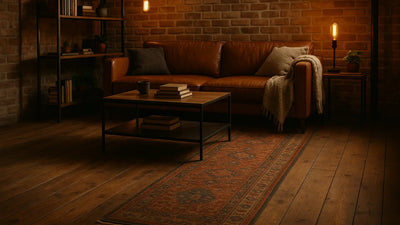
Runner rugs are one of the most bought-wrong categories in home décor. Shoppers either order a runner that's comically short for their hallway or one so wide it leaves no bare floor on either side. This guide gives you the exact formulas for hallways, kitchens, staircases, and entryways — so you get it right the first time.
Standard Runner Rug Sizes
Runner rugs are typically 2 to 3 feet wide and 6 to 14 feet long. The most common widths are 2'6" and 3'; the most common lengths are 6', 8', 10', and 12'. Custom lengths are available for unusual hallways.
| Runner Size | Best Location | Room Width This Fits |
|---|---|---|
| 2' × 6' | Short entry hall, kitchen sink zone | Halls 4'–5' wide |
| 2'6" × 8' | Medium hallway, galley kitchen | Halls 4'6"–5'6" wide |
| 2'6" × 10' | Long hallway, kitchen island walk-around | Halls 4'6"–5'6" wide |
| 3' × 10' | Wide hallway, open-plan entry | Halls 5'–6'+ wide |
| 3' × 12' | Long formal hallway, dining room side | Halls 5'–6'+ wide |
| 2' × 10' or 12' | Narrow hallway or tight galley kitchen | Halls under 4'6" wide |
How to Measure for a Hallway Runner
Follow this exact process for a hallway runner that looks intentional rather than accidental:
- Measure the hallway length. Note the full length from wall to wall.
- Subtract 12–18 inches from each end. This leaves a border of bare floor that frames the rug and prevents the "carpet installation" look. So a 12-foot hallway gets a 9'–10' runner.
- Measure the hallway width. Your runner should be 50–70% of the hallway's width, leaving 3–6 inches of bare floor on each side.
Example Calculations
| Hallway Dimensions | Recommended Runner |
|---|---|
| 4' wide × 8' long | 2'6" × 6' |
| 4'6" wide × 12' long | 2'6" × 10' |
| 5' wide × 14' long | 3' × 12' |
| 6' wide × 20' long | 4' × 18' or two overlapping runners |
How to Choose a Kitchen Runner
Kitchen runners have different priorities than hallway runners: they need to be washable, low-profile (so they don't catch under cabinet doors), and comfortable for standing. Here's how to size them correctly:
- In front of the sink: 20"–24" wide × 4'–5' long. Centered on the sink, not the counter.
- In a galley kitchen (between two counter runs): Measure the length of your working zone; subtract 6" from each end. Width should be 50–60% of the aisle width.
- In front of the range/stove: Same as sink — 20"–24" wide × 4'–5' long.
- Connecting sink and range: Use a continuous 2'6" × 8'–10' runner that bridges both stations.
Shop Runner Rugs at RugKnots
Browse Runner Rugs →Stair Runner Sizing
Stair runners require the most precision because you can't easily return a cut runner.
- Width: Most stairs are 36"–42" wide. A 27"–30" runner leaves 3"–6" of bare stair on each side — the most common aesthetic. For full coverage, match the stair width exactly.
- Length: Measure one stair (tread + riser) and multiply by the number of stairs. Add 10–15% for tucking at the top and bottom. A standard 14-step staircase typically needs 14'–18' of runner.
Runner Material Guide
| Material | Best Location | Durability | Washable? |
|---|---|---|---|
| Wool | Hallways, stairs | ⭐⭐⭐⭐⭐ 15–25 yrs | Spot clean only |
| Polypropylene | Kitchen, entryway, outdoor | ⭐⭐⭐⭐ 8–12 yrs | ✅ Machine washable |
| Cotton | Kitchen, casual hallway | ⭐⭐⭐ 5–8 yrs | ✅ Machine washable |
| Jute | Dry entryways, living areas | ⭐⭐⭐ 5–10 yrs | ❌ Spot clean only |
| Indoor/outdoor blend | Mudrooms, covered patios | ⭐⭐⭐⭐ 10–15 yrs | ✅ Hose washable |
Frequently Asked Questions
How long should a hallway runner be?
Hallway length minus 18"–24" (leaving 9"–12" of bare floor at each end). If your hallway is 10 feet long, use an 8-foot runner. If it's 14 feet, use a 12-foot runner. Matching the exact wall-to-wall length looks like flooring, not a rug.
What width runner rug for a 4-foot hallway?
A 2'6" (30") runner works perfectly in a 4-foot hallway — it leaves 9" of bare floor on each side. Going wider than 36" in a 4-foot hallway starts to crowd the space.
Can I put a runner on top of carpet?
Yes, but use a rug-on-carpet pad (the mesh type, not rubber) to prevent bunching. The runner will shift less than on hard floors. Avoid heavily padded runners over thick carpet — the stack effect becomes a trip hazard.
How do I stop a runner from sliding?
Best options in order of effectiveness: (1) a runner rug pad cut to width, (2) double-sided carpet tape under the corners and center, (3) a runner with an integrated non-slip backing. Tape works well on hard floors; pads are better for carpet.
How many rugs do I need for stairs?
For a typical 14-step staircase, you need one continuous runner of 14–18 feet, depending on your tread depth and how much you fold at each riser. Measure: (tread depth + riser height) × number of steps + 18" for the landing = total length needed.
Find Your Runner Rug at RugKnots — 100s of Styles
Shop All Runner Rugs →Related Buying Guides
About RugKnots
RugKnots is a family-owned rug company based in Hagerstown, Maryland. Founded in 2010, we've spent over 14 years helping homeowners and designers find the right rug — from hand-knotted Persian heirlooms to durable machine-made everyday pieces. We hand-inspect every order before it ships, offer free U.S. shipping, and back every purchase with our 30-day return guarantee.
This article was written by our editorial team and reviewed for accuracy. Our writers work directly with our buyers and customer-experience team, who handle thousands of rug questions every year. If you have a question this article didn't answer, reach out — a real human will get back to you within one business day.