


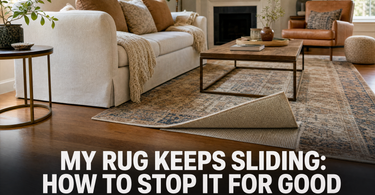
A sliding rug is more than annoying — it's a genuine safety hazard, and it ages the rug faster by grinding the backing against your floor with every footfall. The fix is almost always simple, but which fix depends on what's under your rug. Here's the complete solution by floor type.
Why Rugs Slide
Rugs slide because the surface between the rug backing and the floor has too little friction. Three situations make this worse:
- Smooth flooring: Hardwood, tile, laminate, vinyl, and polished concrete are low-friction surfaces. A flat rug backing has almost nothing to grip.
- Lightweight rugs: Thin flatweave and lightweight polypropylene rugs have less gravitational mass to anchor them. They slide more easily than heavy wool pile rugs.
- Rubber-free backing: Many decorative rugs — especially imported hand-knotted and hand-tufted pieces — have no rubber backing. All the grip has to come from a separate pad.
Solution by Floor Type
Hardwood and Engineered Wood Floors
The best solution: a felt-top / rubber-bottom combination rug pad. The rubber bottom grips the hardwood without scratching or staining the finish. The felt top cushions the rug from below and prevents abrasion of the rug's foundation. This is the only pad type that:
- Grips without adhesive (no residue, no damage to the floor finish)
- Protects the hardwood from scratching under the rug
- Adds cushioning that reduces foot fatigue and noise
What to avoid on hardwood: PVC (polyvinyl chloride) pads. They grip initially but over time can off-gas plasticizers that permanently discolor and dull hardwood finishes. This damage is often not visible until the rug is moved — and it's irreversible.
Pad sizing: Cut the pad 1 inch smaller than the rug on all four sides (so 1/2 inch inset per edge). This prevents the pad from showing and stops the edges from flipping up.
Tile and Stone Floors
Tile and stone are often even more slippery than hardwood because the grout lines don't provide meaningful grip for a rug. The solution is the same — rubber-bottom felt pad — with one addition: make sure the rubber is a non-staining formulation. Some cheaper rubber pads can leave marks on light-colored tile grout. Look for pads specifically marked "safe for tile" or "non-staining rubber."
For bathroom and kitchen tile specifically, prioritize a pad that doesn't trap moisture. Solid rubber (waffle-pattern) pads that allow airflow are better than dense felt pads in wet environments — trapped moisture under a pad causes mildew and floor damage.
Laminate and Luxury Vinyl Plank (LVP)
Laminate and LVP are particularly sensitive to pad chemicals. The surface finish of these floors can be permanently dulled or discolored by plasticizers from PVC pads, sometimes within months. Use only:
- Natural rubber (no PVC) pads
- Felt-only pads (no rubber) if the rug is heavy enough to stay put without grip
Many manufacturers of laminate and LVP flooring specify in their warranty documentation which pad materials are approved. Check your flooring warranty before selecting a pad.
Low-Pile Carpet
Rugs on carpet slide differently — the rug's backing moves against the carpet's surface fibers. The solution: a waffle rubber pad (sometimes called a "rug-on-carpet" pad). These have an open waffle texture that grips carpet loops without damaging them. Avoid felt/rubber combination pads on carpet — the felt bottom slides on carpet just like the rug does.
High-Pile or Shag Carpet
High-pile carpet is the most challenging surface for rug placement. The long fibers create an uneven, unstable base that causes any rug on top to rock and migrate. Solutions:
- Double-sided carpet tape around the perimeter (most secure, but removal requires care)
- Heavy-duty rug anchors that pin through the carpet into the backing
- Simply accepting that large, heavy rugs on high-pile carpet will shift slightly — and re-centering periodically
When a Pad Isn't Enough: Other Causes of Sliding
The Pad Is Too Small
A pad that doesn't extend close to the rug's edges leaves the outer portions of the rug unsecured. The edges curl up and catch foot traffic, the rug torques, and it migrates. Always size the pad to within 1 inch of each edge — not dramatically smaller.
The Pad Has Aged Out
Rubber pads degrade over time. Natural rubber pads last 4–6 years. PVC pads last 2–3 years before they begin to harden and lose grip. If your pad is more than a few years old and has started hardening, cracking, or leaving residue, replace it — it's no longer gripping.
The Rug Has Curling Edges
New rugs often have curling edges from being rolled during shipping. The corners and edges lift off the floor and catch foot traffic, causing the rug to shift even with a pad. Solutions:
- Roll the rug in the opposite direction overnight with something heavy on the edges
- Use a rug corner gripper (small wedge-shaped gripper that sits under curled corners)
- In most cases, curling resolves itself within 1–2 weeks as the rug flattens under its own weight
Double-Sided Carpet Tape: When to Use It
Carpet tape is the most secure rug anchoring solution available — but it comes with caveats:
- Use on:** Tile, low-pile carpet, painted concrete, vinyl tile
- Avoid on:** Hardwood and laminate (adhesive residue is very difficult to remove and can damage finishes)
- Application:** Apply tape around the perimeter of the rug (not in the middle) so the rug can expand slightly with humidity changes without buckling
The Right Rug Pad for Your Situation
| Floor Type | Best Pad | Avoid |
|---|---|---|
| Hardwood | Natural rubber + felt combination | PVC, adhesive backing |
| Tile / Stone | Natural rubber + felt (non-staining) | Dense felt in wet areas |
| Laminate / LVP | Natural rubber (no PVC) | PVC — voids flooring warranty |
| Low-pile carpet | Waffle rubber (rug-on-carpet type) | Felt/rubber combo |
| High-pile carpet | Double-sided tape or heavy rug anchor | Standard pads alone |
Buying a New Rug? Look for These Features
If you're shopping for a new rug and sliding is a concern, certain rug types arrive more slide-resistant:
- Rubber-backed rugs: Many kitchen and bathroom runners come with latex rubber backing. Check the product description — it eliminates the need for a separate pad.
- Heavier wool rugs: A heavy hand-knotted wool rug naturally slides less than a lightweight polypropylene rug due to mass alone.
- Low-pile construction: Lower-profile rugs are less susceptible to the torquing forces that cause sliding than high-pile shag rugs.
Browse RugKnots:
- Heavy hand-knotted wool rugs — naturally stay in place
- Machine-made rugs — many with rubber backing options
About RugKnots
RugKnots is a family-owned rug company based in Hagerstown, Maryland. Founded in 2010, we've spent over 14 years helping homeowners and designers find the right rug — from hand-knotted Persian heirlooms to durable machine-made everyday pieces. We hand-inspect every order before it ships, offer free U.S. shipping, and back every purchase with our 30-day return guarantee.
This article was written by our editorial team and reviewed for accuracy. Our writers work directly with our buyers and customer-experience team, who handle thousands of rug questions every year. If you have a question this article didn't answer, reach out — a real human will get back to you within one business day.

)