Most rug companies buy from importers who buy from distributors who buy from regional wholesalers who buy from middlemen who buy from the weavers. By the time a rug reaches a US retailer through that chain, it has passed through 4–6 hands, each adding margin, and the person selling it to you has never seen the village it came from, met the weaver who made it, or knows whether the dyes used will hold for 5 years or 50.
RugKnots was built on a different premise.
Direct From the Source
For over three decades, RugKnots has sourced rugs directly from the workshops and cooperatives that produce them — in Afghanistan, Pakistan, Iran, Turkey, and India. Not through importers. Not through distributors. Directly from the families and artisans who tie each knot.
This matters for two reasons: quality and price.
Quality: We Know What We're Buying
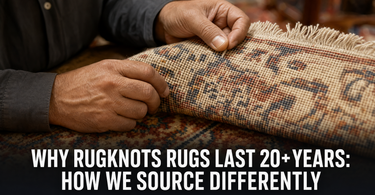
When you buy a rug from RugKnots, someone on our team has personally evaluated the wool grade, verified the knot count, checked the dye lot for consistency, and inspected the finishing. We know which workshops use high-altitude Ghazni wool (longer fibers, better resilience) versus lower-quality lowland wool. We know which dyers use natural vegetable dyes that age to beautiful patina versus synthetic dyes that fade unevenly. We know which weavers finish their edges properly and which cut corners.
You can't know any of this if you're five steps removed from the production.
Price: Cutting Out 4 Middlemen
Every hand a rug passes through adds 20–40% to the price. When we source directly from the weaving workshops, we eliminate four to six of those margins. A rug that would cost $2,000 at a retail importer — because it passed through an importer, a national distributor, a regional dealer, and a retailer — costs significantly less at RugKnots, because we're the first buyer after the weaver.
This is why our hand-knotted rugs are priced the way they are. It's not that we're compromising on quality. It's that we're not paying for a chain of intermediaries.
The Wool Standard
The single biggest determinant of how long a rug will last is the quality of the wool used to make it. Not the pattern. Not the size. The wool.
We prioritize:
- Ghazni wool from Afghanistan — sheep raised at 7,000+ feet elevation produce longer, denser, more resilient fiber than lowland animals. The cold forces the sheep to grow denser fleece. This wool has been the benchmark for quality hand-knotted rug production for centuries.
- First-clip wool — sheared in spring before summer heat affects fiber quality. The first clip of the year produces the longest, strongest fibers.
- Hand-spun where possible — hand-spun wool has a slight irregularity that creates visual depth in the finished pile and a different texture than machine-spun. Many of the great antique rugs that have lasted 100+ years used hand-spun wool.
The Dye Standard
Dye quality determines how a rug ages. Synthetic dyes — the type used in most commercially produced rugs — can fade unevenly, bleed when wet, or shift color over 10–15 years in ways that are difficult to predict and impossible to reverse.
We prefer natural and chrome dyes:
- Natural vegetable dyes — derived from plants (madder root for red, indigo for blue, pomegranate for yellow) that have been used by Persian and Central Asian weavers for centuries. Natural dyes fade beautifully — they develop the "abrash" (subtle color variation) that makes antique rugs so visually rich. A naturally dyed rug that has faded 10% over 30 years looks better than the day it was made.
- Chrome dyes — a high-quality synthetic dye process that is colorfast, UV-resistant, and consistent. Used in the best quality commercial production. Preferable to standard acid dyes in terms of longevity.
Why "Hand-Knotted" Isn't Enough
We want to be direct about something: "hand-knotted" has become a marketing term that obscures significant quality variation. A rug with 40 knots per square inch and poor-quality wool labeled "hand-knotted" will not last as long as the label implies. A rug with 150+ KPSI and high-altitude Ghazni wool will justify the "heirloom" language.
When we describe a rug as hand-knotted at RugKnots, we can tell you:
- The specific knot count (KPSI)
- The wool grade and region of origin
- The dye type
- The weaving region and workshop type
We can tell you these things because we were there when the rugs were made, or our team was.
The 20-Year Test
We've been selling rugs for over 35 years. We know which types of rugs customers are still calling us about 20 years later — sending photos of pieces that have developed beautiful patina, asking about care as they plan to pass them to the next generation. And we know which types of rugs customers called about at year 5 with complaints about flattening, fading, or backing failure.
The 20-year rugs are always: high-altitude wool, tight knotting, quality dyes. No exceptions. We built our sourcing around that pattern.
Shop With That Standard in Mind
Every hand-knotted rug at RugKnots is sourced with these standards applied. We don't carry everything — we carry what we'd put in our own homes.
Browse hand-knotted rugs sourced directly from the weavers →
Read: 37 years of rug sourcing — what we've learned about quality and value →
About RugKnots
RugKnots is a family-owned rug company based in Hagerstown, Maryland. Founded in 2010, we've spent over 14 years helping homeowners and designers find the right rug — from hand-knotted Persian heirlooms to durable machine-made everyday pieces. We hand-inspect every order before it ships, offer free U.S. shipping, and back every purchase with our 30-day return guarantee.
This article was written by our editorial team and reviewed for accuracy. Our writers work directly with our buyers and customer-experience team, who handle thousands of rug questions every year. If you have a question this article didn't answer, reach out — a real human will get back to you within one business day.