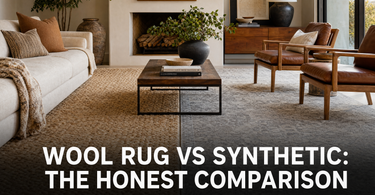
Wool rugs cost more. That's the opening fact, and it's worth examining whether that premium is justified for your specific situation. The answer isn't the same for everyone.
Table of Contents
Durability
Wool fiber has natural crimp — a wave structure at the microscopic level that lets it compress under foot traffic and spring back. This is why a good wool rug can look essentially the same after 10 years in a living room. The fiber recovers from compression rather than flattening permanently.
Polypropylene (the most common synthetic rug material) is initially resistant to staining and affordable, but it doesn't recover from compression the same way. Under consistent foot traffic, the pile flattens, and once it's flat, it stays flat. A polypropylene rug in a high-traffic area typically shows its age within 3–5 years. A comparable quality wool rug in the same location might look good for 10–15 years.
Nylon is the exception among synthetics — it recovers from compression reasonably well and is genuinely durable. It's used in commercial carpet for good reason. But most mid-range area rugs sold as "synthetic" are polypropylene, not nylon.
"At RugKnots, we've been importing and selling hand-knotted rugs since 1987. The right rug doesn't just tie a room together—it sets the foundation for how you live in that space."
Feel
Wool has a warmth and softness that polypropylene doesn't replicate convincingly. Part of this is thermal — wool actually insulates, trapping warmth near the floor. Part of it is tactile — the crimp in wool fiber creates a texture that reads as plush in a way that polypropylene, even at high pile heights, doesn't quite match.
New wool rugs sometimes have a scratchy quality that softens with use and cleaning over the first year. This is lanolin and residual processing — not a defect. Polypropylene is immediately soft but has a slightly plasticky hand that some people dislike.
Price
A decent polypropylene 8x10 area rug starts around $150–300. A comparable wool rug starts around $400–700 for machine-made, $800+ for hand-tufted, and $1,500+ for hand-knotted. The gap is real.
But cost-per-year math often favors wool. A $250 synthetic rug that needs replacing every 4 years costs $62.50/year. A $600 wool rug that lasts 12 years costs $50/year — and it will look better in year 8 than the synthetic does in year 2.
Maintenance
This is where synthetic wins clearly. Polypropylene is hydrophobic — it doesn't absorb water or most liquid stains. Spills bead up and can be blotted away. Most polypropylene rugs can be hosed off outdoors or even cleaned in a large washing machine.
Wool requires more care. It absorbs moisture (which is actually part of why it feels warm), which means spills need attention quickly. It cannot go in a standard household washing machine without shrinking or felting. Dry cleaning or professional wet cleaning is recommended for thorough cleaning.
However: wool's natural lanolin gives it some inherent stain resistance, and it doesn't attract and hold pet hair the way synthetic fiber does. It's a trade-off, not a clear loss.
Allergens
The claim that wool rugs are hypoallergenic is not fully accurate, but it's not entirely wrong either. Wool doesn't support dust mite populations as readily as synthetic fiber, and it doesn't off-gas VOCs (volatile organic compounds) the way some synthetic rugs do, especially when new.
For people with lanolin sensitivity (rare but real), wool rugs can cause skin reactions. For people sensitive to synthetic off-gassing (the "new carpet smell"), wool is the better choice. If allergens are a serious concern, consult your allergist — this isn't a simple wool-wins situation.
Environmental Impact
Wool is renewable — sheep are shorn annually, and the fiber is biodegradable. Polypropylene is petroleum-derived and will sit in a landfill for centuries after disposal. From a lifecycle perspective, wool is significantly lower impact, especially if the rug lasts 15+ years.
The caveats: wool production has land-use and methane implications from sheep grazing. And a wool rug that lasts 5 years because it was poorly maintained is worse than a synthetic rug used for 10. Longevity is the biggest environmental variable.
The Honest Summary
- Buy wool if: You want durability, you have time for basic maintenance, you care about environmental impact, or you're furnishing a room you'll be in for 10+ years
- Buy synthetic if: Budget is the primary constraint, it's a kids' room that will need frequent washing, you need something outdoors or in a high-moisture area, or it's a short-term solution
- Buy nylon if: You want synthetic durability without committing to wool — it's the middle-ground that doesn't get enough attention
Related Articles
- How Long Do Wool Rugs Last? What to Expect
- How to Clean a Wool Rug Without Ruining It
- Washable Rugs: Are They Actually as Good as Regular Rugs?
Frequently Asked Questions
Are these rugs durable?
Yes, they are designed for durability and long-lasting wear, especially in high-traffic areas.
How do I clean this type of rug?
Regular vacuuming without a beater bar is recommended. For specific spills, spot clean immediately with mild soap and water.
Do I need a rug pad?
Yes, we always recommend a high-quality rug pad to prevent slipping, add cushioning, and extend the life of your rug.
Are they safe for pets and kids?
Absolutely. The materials are safe, and the construction is designed to withstand active households.
Can these rugs be used outdoors?
Unless specifically marked as an indoor/outdoor rug, we recommend keeping them indoors to prevent weather damage.
Related Buying Guides
About RugKnots
RugKnots is a family-owned rug company based in Hagerstown, Maryland. Founded in 2010, we've spent over 14 years helping homeowners and designers find the right rug — from hand-knotted Persian heirlooms to durable machine-made everyday pieces. We hand-inspect every order before it ships, offer free U.S. shipping, and back every purchase with our 30-day return guarantee.
This article was written by our editorial team and reviewed for accuracy. Our writers work directly with our buyers and customer-experience team, who handle thousands of rug questions every year. If you have a question this article didn't answer, reach out — a real human will get back to you within one business day.