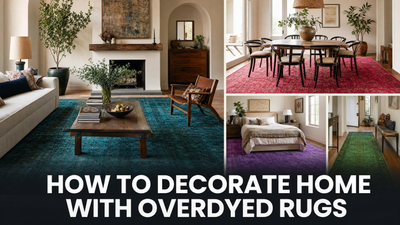
Overdyed rugs are visually confident—a bold cobalt blue or fuchsia rug demands attention. That's precisely their appeal, but it also means styling them requires a clear approach. Here's how to work with an overdyed rug rather than around it.
The Fundamental Rule: Let the Rug Win
An overdyed rug is the visual centerpiece of any room it enters. Accept that from the start and design accordingly. Your job isn't to compete with it—it's to give it a strong supporting cast that allows the rug's color and character to land properly.
Pairing Jewel Tones with Neutrals
The classic approach: surround an overdyed rug with a neutral field and let it be the only color event in the room.
- Cobalt or navy overdyed rug: White walls, natural linen sofa, raw wood or light oak furniture. The blue rug reads like an art piece on the floor.
- Fuchsia or magenta rug: Warm white or greige walls, charcoal or taupe upholstery—the contrast is dramatic but controlled. Add a single brass or gold accent to warm the combination.
- Emerald green rug: White, cream, or warm gray walls. Natural fibers (linen, cotton, jute) in the furnishings. Avoid other greens in the room—the rug is enough.
- Burnt orange or teal: These work beautifully with warm wood tones, natural plaster walls, and leather upholstery.
How the Pattern Shows Through the Dye
One of the most appealing qualities of an overdyed rug is the ghost of the original pattern visible beneath the new color. Areas with denser original weaving absorb the new dye differently, creating subtle variation—a faint medallion, a border that reads as a slightly different shade, a field that shifts in tone.
Use this quality as part of your styling:
- Place the rug where it will be viewed from a distance—this is where the pattern-through-dye effect is most visible and most beautiful
- Avoid obscuring the center of the rug under a large coffee table—leave the field visible so the underlying pattern can be appreciated
- Keep other patterns in the room minimal; the rug's own internal pattern complexity is more than enough visual interest
Best Rooms for Overdyed Rugs
- Living rooms: The highest-impact use. An overdyed rug transforms a neutral living room immediately.
- Dining rooms: Particularly effective under round or oval dining tables—the circular form complements the often-circular medallion compositions visible through the dye.
- Home offices: An overdyed rug in a study or home office adds character to what can otherwise be a sterile, utilitarian space.
- Bedrooms: A jewel-toned overdyed rug under the bed with exposed runners on either side creates a luxurious effect.
- Less ideal: Kitchens and bathrooms—overdyed rugs are typically vintage wool, which doesn't handle moisture and high-traffic spills as well as synthetic materials.
What to Avoid
- Mixing multiple bold colors in the room alongside the rug—the rug should be the color anchor, not one of several competing elements
- Patterned upholstery—a heavily patterned sofa fights the rug rather than supporting it
- Rugs that are too small for the space—overdyed rugs need enough scale to carry the color story properly
Related Articles
- What Are Overdyed Rugs? How They're Made and Why They're Trending
- Overdyed Rugs vs Traditional Vintage Rugs: Which Should You Buy?
About RugKnots
RugKnots is a family-owned rug company based in Hagerstown, Maryland. Founded in 2010, we've spent over 14 years helping homeowners and designers find the right rug — from hand-knotted Persian heirlooms to durable machine-made everyday pieces. We hand-inspect every order before it ships, offer free U.S. shipping, and back every purchase with our 30-day return guarantee.
This article was written by our editorial team and reviewed for accuracy. Our writers work directly with our buyers and customer-experience team, who handle thousands of rug questions every year. If you have a question this article didn't answer, reach out — a real human will get back to you within one business day.