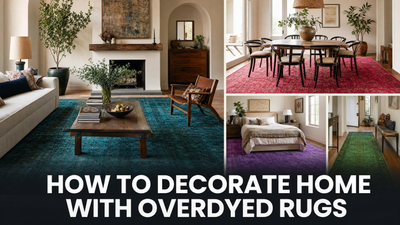
Overdyed rugs have been one of the most talked-about trends in the rug world for the past decade—and they're still going strong. Here's exactly what they are, how they're made, and why they've captured so much attention.
What Is an Overdyed Rug?
An overdyed rug is a vintage or antique rug—most commonly Persian, Turkish, or Afghan—that has been stripped of its original colors and re-dyed in a single bold hue. The result is a piece that carries the intricate weave structure and irregular texture of an old rug, transformed into a striking contemporary color statement.
The most popular overdye colors are jewel tones: deep fuchsia, cobalt blue, emerald green, burnt orange, and electric teal. The original pattern doesn't disappear entirely—it shows through the new color as a subtle ghost of the underlying design, which is part of what makes overdyed rugs so visually interesting.
How the Overdyeing Process Works
The process involves several steps:
- Selection: Artisans select vintage rugs that have good structural integrity (tight weave, no major holes) but may be faded, worn in color, or too damaged in their original palette to sell as-is. Many are old tribal rugs, village pieces, or distressed Persians.
- Stripping: The original dye is chemically stripped from the wool fibers, or the rug is washed aggressively to fade existing color. This lightens the base so the new dye can saturate evenly.
- Re-dyeing: The rug is submerged in a dye bath, often by hand in large vats in workshops in Turkey, India, or Iran. The dye penetrates the old wool, but unevenly—areas with more original dye resist the new color, creating the characteristic variation and pattern-ghost effect.
- Washing and finishing: The rug is washed, stretched back into shape, and often given a final chemical wash to create additional distressing or sheen.
Why Vintage Bases Make Better Overdyed Rugs
New rugs can be overdyed, but the results are less interesting. Old wool—often hand-spun, from sheep raised in harsh climates—has a different texture and dye-uptake behavior than modern machine-spun yarn. It holds the new dye less uniformly, creating the depth and variation that define a truly beautiful overdyed rug. The underlying pattern from decades of weaving adds another layer of visual complexity that a new rug simply can't replicate.
Why Overdyed Rugs Are Still Trending
- They solve a real problem: They offer the warmth and handmade quality of a vintage rug with colors that work in contemporary interiors—a combination that's genuinely hard to find otherwise.
- Each piece is unique: No two overdyed rugs are exactly alike because each starts from a different vintage base. You're getting something truly one-of-a-kind.
- Bold color with built-in complexity: A solid-colored rug can feel flat. An overdyed rug in cobalt blue with a ghost of a medallion beneath the surface is anything but flat.
- Sustainability angle: Repurposing a worn vintage rug into something beautiful has genuine appeal in an era of greater consciousness about consumption.
What to Look for When Buying
- Check the pile height—overdyeing can sometimes weaken fibers, so look for rugs with consistent, intact pile
- Examine the fringe—fringes often show the most chemical stress from the stripping process
- Ask about the base rug origin if it matters to you; Turkish and Persian bases tend to use high-quality wool that handles the process well
Related Articles
- How to Style an Overdyed Rug: Bold Color in Any Room
- Overdyed Rugs vs Traditional Vintage Rugs: Which Should You Buy?
About RugKnots
RugKnots is a family-owned rug company based in Hagerstown, Maryland. Founded in 2010, we've spent over 14 years helping homeowners and designers find the right rug — from hand-knotted Persian heirlooms to durable machine-made everyday pieces. We hand-inspect every order before it ships, offer free U.S. shipping, and back every purchase with our 30-day return guarantee.
This article was written by our editorial team and reviewed for accuracy. Our writers work directly with our buyers and customer-experience team, who handle thousands of rug questions every year. If you have a question this article didn't answer, reach out — a real human will get back to you within one business day.