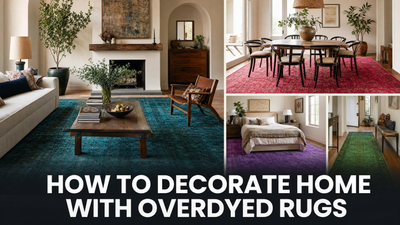
Both overdyed and traditional vintage rugs start from the same place—old handmade rugs with genuine history. But they end up in very different places. Here's a side-by-side comparison to help you decide which is right for your situation.
What You're Actually Comparing
A traditional vintage rug is sold in its original or near-original state—aged, perhaps with some wear or fading, but with the pattern and colors as the original weaver intended. An overdyed rug has been stripped and re-dyed, transforming the color story while preserving the physical structure of the original weave.
Price Comparison
- Traditional vintage rugs: Price is determined by origin, age, condition, rarity of design, and quality of weaving. A faded or worn vintage rug with a recognizable pattern from a sought-after region (Kashan, Tabriz, early 20th century Heriz) can be quite expensive. A village rug in poor color condition might be very affordable.
- Overdyed rugs: Often priced similarly to mid-range vintage rugs. The overdyeing process adds labor cost, and the transformation makes less-desirable vintage pieces sellable at reasonable prices. You're generally paying for the result, not the provenance.
If budget is the primary concern and you want the hand-knotted quality, an overdyed rug often offers better value per square foot than a collectible traditional vintage piece.
Durability
- Traditional vintage rugs: Intact vintage rugs with good pile and no structural damage are highly durable. They've already survived decades—with proper care, they'll survive decades more.
- Overdyed rugs: The chemical stripping process can weaken wool fibers, particularly if the original rug was already fragile. A well-executed overdye on a structurally solid base is durable; a poorly executed one on a damaged base may shed or deteriorate faster. Inspect pile carefully before buying.
What You Gain with Overdyeing
- Bold, contemporary color in a handmade format—rare and genuinely difficult to find in traditional vintage rugs
- A unique piece that can function in modern or eclectic interiors without looking like it wandered out of a traditional room
- The character and texture of a vintage rug without the color constraints of the original design
What You Lose with Overdyeing
- The original color palette and full visual clarity of the underlying pattern—these are permanently altered
- Collectibility and investment value—overdyed rugs are generally not considered collectible in the way that authentic vintage rugs in original condition are
- Provenance integrity—an overdyed rug cannot be restored to its original state
- Some fiber integrity—depending on the quality of the process, the wool may be somewhat weaker than an untreated vintage piece
Who Should Buy Which
- Buy a traditional vintage rug if: You want authentic character, you're interested in collecting or investment potential, your room needs warm and complex traditional color, or you value the integrity of the original craft
- Buy an overdyed rug if: You want the texture and handmade quality of a vintage piece with a bold, contemporary color, you're furnishing a modern or eclectic interior, or you want something unique at a price point below the finest vintage pieces
Related Articles
- What Are Overdyed Rugs? How They're Made and Why They're Trending
- How to Style an Overdyed Rug: Bold Color in Any Room
About RugKnots
RugKnots is a family-owned rug company based in Hagerstown, Maryland. Founded in 2010, we've spent over 14 years helping homeowners and designers find the right rug — from hand-knotted Persian heirlooms to durable machine-made everyday pieces. We hand-inspect every order before it ships, offer free U.S. shipping, and back every purchase with our 30-day return guarantee.
This article was written by our editorial team and reviewed for accuracy. Our writers work directly with our buyers and customer-experience team, who handle thousands of rug questions every year. If you have a question this article didn't answer, reach out — a real human will get back to you within one business day.