





Quick answer: Persian rugs are expensive because every one is knotted by hand, one knot at a time, over months or years. A 9x12 holds roughly 1.5 to 5 million knots, tied at 6,000 to 12,000 a day by a single weaver. Add hand-spun Kurk wool or silk, plant-based dyes, the prestige of cities like Tabriz, Isfahan and Qum, the scarcity created by U.S. sanctions on Iranian imports, and a lifespan of 50 to 100-plus years, and the price reflects what you are buying: a hand-made textile that outlives its owner.

Walk into a rug showroom and the numbers can feel absurd: $4,000 for an 8x10 here, $40,000 for a smaller rug two rows over, and a machine-made "Persian-style" rug for $300 by the door. All three look, at a glance, like the same thing. They are not. This guide walks through each factor that sets the price, with real numbers, so you can read a price tag and know whether it is fair. If you want the price tables first, our companion post on how much Persian rugs are worth lists ranges by size and grade; this post explains the why.
How Much Does a Persian Rug Cost? (Quick Price Ranges)
Before the reasons, a snapshot so the rest of the article has context. These are typical U.S. retail ranges in 2026 for genuine hand-knotted Persian (Iranian) rugs.
| Size and grade | Entry | Mid-grade | High-end |
|---|---|---|---|
| 3x5 village or tribal wool (Hamadan, Shiraz, Baluch) | $300–$800 | $900–$1,400 | $2,000+ |
| 5x7 city wool (Kashan, Tabriz, Kerman) | $1,200–$2,500 | $2,600–$4,000 | $5,000+ |
| 8x10 city wool (Kashan, Tabriz, Heriz) | $2,800–$5,500 | $6,000–$10,000 | $12,000+ |
| 9x12 fine city (Isfahan, Nain, fine Tabriz) | $10,000–$18,000 | $18,000–$35,000 | $50,000+ |
| Silk Qum, any size over 4x6 | $8,000–$15,000 | $15,000–$40,000 | $100,000+ |
| Antique palace size (10x14+) | — | $25,000–$60,000 | $70,000 to six figures |
Per square foot, that works out to roughly $35 to $70 for village rugs, $70 to $150 for workshop city rugs, $100 to $450 for fine city rugs and $400 to well over $1,000 for silk masterpieces and important antiques. Everything below explains where those gaps come from.
Hand-Knotting: Months to Years of Labor
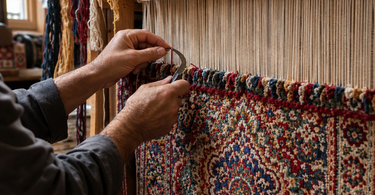
This is the single biggest cost, and it is easy to underestimate. A Persian rug is not woven on a machine that shoots a shuttle back and forth; a weaver sits at a vertical loom, wraps a short length of wool around two warp threads, pulls it tight, cuts it, and moves to the next pair. Thousands of times a day, for months. After each row, a weft thread is passed through and the row is beaten down with a heavy comb to lock it in place.
The math is what convinces most skeptics. A 9x12 rug has 15,552 square inches of surface. At a modest 120 knots per square inch (KPSI), that is about 1.9 million knots. At 300 KPSI, a good city rug, it is 4.7 million. An experienced weaver ties 6,000 to 12,000 knots a day, so:
| Rug | Knots per sq in | Total knots | One weaver at 8,000 knots/day |
|---|---|---|---|
| 5x8 village rug | 100 | 576,000 | About 3 months |
| 8x10 workshop rug | 200 | 2.3 million | About 10 months |
| 9x12 fine city rug | 300 | 4.7 million | About 20 months |
| 4x6 silk Qum | 600 | 2.1 million | About 9 months, with finer, slower knots |
Large rugs are usually worked by two or three weavers side by side, which shortens the calendar time but not the labor hours. Then come the finishing trades: the rug is washed, sheared to an even pile, its edges overcast, its fringe finished and, in city workshops, its design checked against the cartoon (the gridded pattern drawing) by a master. Even at Iranian wages, a year of skilled labor is a year of skilled labor.
Knot density (KPSI) and how it affects price

KPSI is the number of knots in one square inch, counted on the back. Higher density means finer yarn, more knots per rug, a slower weaver and sharper curves in the design, which is why it tracks price so closely.
- 80–150 KPSI: tribal and village rugs (Heriz, Hamadan, Shiraz, Bakhtiari). Bold geometric designs, the most affordable authentic Persian rugs and often the most durable, because the wool is thick.
- 150–350 KPSI: workshop city rugs (Kashan, Tabriz, Kerman, Mashhad). Curvilinear florals and medallions, the heart of the market.
- 350–600+ KPSI: fine city rugs (Isfahan, Nain, fine Tabriz, Qum). Silk highlights are common; prices climb steeply.
- 1,000+ KPSI: masterpiece silk pieces from Qum and Isfahan, usually signed, priced like art.
Density is not everything, though. A 100-KPSI Heriz with great wool and color can outlast and outvalue a mediocre 400-KPSI rug. Density is a multiplier on quality, not a substitute for it. Our guide to identifying an authentic Persian rug shows how to count knots yourself.
Premium Materials: Kurk Wool, Silk and Cotton Foundations
The second cost driver is what the knots are made of. Machine-made rugs use polypropylene or nylon that costs a few dollars per pound. Persian rugs use fibers that have to be raised, sheared, sorted, hand-spun and dyed.
Kurk (kork) wool is the prize. It is the first shearing of a lamb, or the wool from the neck and underbelly of a sheep, where the fiber is longest, finest and richest in lanolin. It feels almost like silk, takes dye deeply and resists soil because the lanolin makes spills bead up. Hand-spun Kurk wool from Iran's highland flocks is one reason a Kashan or Isfahan feels different underfoot from a rug made with commercial mill-spun wool.
Silk multiplies cost several times over. It is more expensive per pound, harder to knot because it is slippery, and it demands higher knot counts to look right. Silk appears three ways: as highlights that outline flowers in a wool rug, as an all-silk pile in Qum and some Kashan and Isfahan pieces, and as the foundation (warp and weft) of the very finest rugs, where a silk warp allows knot counts above 600. An all-silk Qum is the most expensive new Persian rug you can buy.
Cotton foundations are the norm for city rugs because cotton holds a flat, stable shape; tribal rugs often use wool warps, which give them their slightly wavy character. Either way, the foundation is another hand-prepared material, and the fringe you see at the ends is simply those warp threads, not a decoration sewn on afterward.
Natural Vegetable Dyes and Abrash

Color is the third driver. Traditional Persian dyers still use plants and insects: madder root for reds and terracottas, indigo for every blue, pomegranate rind, weld and saffron for yellows and golds, walnut husks and oak galls for browns and near-blacks, and cochineal for crimson. The wool is mordanted with alum, simmered in the dye bath, sometimes over-dyed (indigo then yellow for green) and dried in the sun. Each batch takes days and no two are identical.
That last point is where abrash comes from: the subtle horizontal bands of lighter and darker color you see across the field of a hand-dyed rug, produced when the weaver moves from one dye lot to the next. Machine-made rugs are perfectly uniform and look flat because of it. Natural dyes also age differently. Instead of fading to gray, they mellow and soften over decades, which is why a 90-year-old Heriz can look better than it did new, and why collectors pay a premium for it. Quality synthetic chrome dyes, used in many workshop rugs since the mid-20th century, are stable and perfectly respectable; the price premium belongs to full vegetable dyeing done well.
Region of Origin: Tabriz, Kashan, Isfahan, Kerman, Heriz and Qum

A Persian rug is named for where it was woven, and the name carries a reputation built over centuries, the way a wine appellation does. Two rugs of the same size and knot count can differ in price by half simply because of their origin.
| Origin | Known for | Typical KPSI | Price position |
|---|---|---|---|
| Tabriz | Central medallions, Mahi (fish) design, pictorials; the widest range of grades. Famous workshops: Haj Jalili, Benam. | 150–700 | Mid to very high |
| Kashan | Red-and-navy floral medallions in fine Kurk wool. Antique Mohtasham Kashans are among the most sought-after rugs in the world. | 150–400 | Mid to high |
| Isfahan | Ivory grounds, silk highlights, silk foundations, signed pieces (the Seirafian family). | 400–800 | High |
| Nain | Ivory, blue and beige palette with silk outlines; graded by "La" (ply), with 4La and 6La the finest. | 300–700 | High |
| Qum (Qom) | Pure silk rugs with jewel-like detail, often signed. | 500–1,000+ | Highest |
| Kerman | Soft pastels, elaborate floral and pictorial designs, the "American Kerman" of the 1920s–50s. | 150–350 | Mid to high |
| Heriz / Serapi | Bold geometric medallions in rust and blue on thick, hard-wearing wool. Antique Serapis fetch six figures. | 60–120 | Entry to very high (antique) |
| Bakhtiari | Garden-panel (khesti) designs, robust village weaving. | 80–150 | Entry to mid |
Within each city, a signature adds another layer. Rugs woven under a named master (Seirafian in Isfahan, Haj Jalili in Tabriz, Habibian in Nain, Amoghli in Mashhad) carry the workshop's name in the border and sell at a premium the way a signed print does. Curious about the Bakhtiari end of the range? See our guide to Bakhtiari rugs.
Age and Rarity: New vs Semi-Antique vs Antique Persian Rugs

The rug trade sorts by age: new (under about 30 years), semi-antique (50 to 99 years) and antique (100 years or more). For most manufactured goods, age subtracts value. For a well-made Persian rug it often adds it, for three reasons.
First, survivorship. Of the rugs woven in Tabriz in 1920, only a fraction survive in good condition, so each one is rarer every year. Second, patina. Decades of light and wear soften natural dyes and polish the wool into a sheen that new rugs lack, and designers pay for that look. Third, provenance. A rug woven in the great period of Persian weaving (roughly 1870 to 1930), or under a known master, is a documented object with a history. That is why an antique Serapi at 80 KPSI can cost more than a new 500-KPSI Isfahan, and why an 18th-century fragment can be worth more than a perfect modern room-size rug.
Condition still rules. Even wear and softened color are patina; worn-through foundation, moth damage, dry rot and amateur repairs are damage, and they cut value sharply. Our vintage rug collection is where semi-antique pieces live at RugKnots.
Sanctions, Supply and Market Demand
Here is the factor most guides skip. The United States has banned the import of Iranian goods, carpets included, for most of the past four decades: an embargo from 1987, a carve-out for carpets and foodstuffs from 2000, a renewed ban in September 2010, a reopening under the 2016 nuclear agreement, and a return to full prohibition in August 2018 that remains in force. New Persian rugs cannot legally enter the U.S. today.
The result is a fixed pool. Every genuine Persian rug for sale in America either arrived before 2010, slipped in during the 2016 to 2018 window, or has been in the country for decades. Dealers cannot restock from Iran, so as the good pieces sell, the remaining supply thins and prices firm up. It also explains why so many "Persian" rugs sold in the U.S. are actually Persian-design rugs woven in Pakistan, India, Afghanistan or Turkey, which are legal to import and, all else equal, cost less. Our post on Pak-Persian rugs covers the best of that category.
Demand pulls in the other direction. Persian rugs are collected worldwide, so U.S. buyers compete with buyers in Europe, the Gulf and East Asia for the same antique and semi-antique pieces at auction. Scarce supply plus global demand is the textbook recipe for a high price.
Are Persian Rugs a Good Investment? (Auction Records)
The headline numbers are real. In June 2013, the 17th-century Clark Sickle-Leaf carpet sold at Sotheby's in New York for $33.8 million, still the record for any rug. In 2010 a 17th-century Kirman "vase" carpet sold at Christie's in London for about $9.6 million. Fine antique Kashans, Serapis and Tabrizes regularly bring $50,000 to $500,000.
The honest answer for the rest of us is more measured. A new decorative Persian rug bought at retail is not a financial investment; like a new car, it usually resells below its purchase price for its first decade. What it is is a durable asset: a good hand-knotted rug lasts 50 to 100 years, holds meaningful resale value throughout, and can appreciate once it crosses into semi-antique territory, especially if it is a well-known type in excellent condition. Antique and signed pieces bought knowledgeably have historically held or grown in value. If you want to think about it as an investment, buy the best quality you can afford in a classic design, keep it clean and out of direct sun, and keep the paperwork. We go deeper in why Persian rugs are a smart home investment.
Hand-Knotted Persian vs Machine-Made and Persian-Style Rugs: Price Comparison
The clearest way to see what you are paying for is to line up an 8x10 in each construction.
| 8x10 rug type | How it's made | Typical price | Expected life |
|---|---|---|---|
| Machine-made "Persian-style" | Power loom, polypropylene or polyester, printed or woven pattern, sewn-on fringe | $150–$800 | 5–10 years |
| Hand-tufted Persian design | Tufting gun through canvas, latex glue, wool pile | $300–$1,200 | 7–15 years |
| Hand-knotted Persian design from India or Pakistan | Hand-knotted wool, 100–300 KPSI | $1,500–$5,000 | 30–60 years |
| Hand-knotted Persian city wool (Kashan, Tabriz, Heriz) | Hand-knotted Kurk wool, 150–350 KPSI, Iranian origin | $2,800–$12,000+ | 50–100 years |
| Fine Persian (Isfahan, Nain, silk Qum) | Hand-knotted, silk highlights or all silk, 400–1,000 KPSI | $15,000–$100,000+ | 100+ years |
Divide price by years and the picture changes. A $6,000 Kashan that serves 75 years costs about $80 a year; a $600 machine-made rug replaced every 7 years costs about $86 a year, and never becomes anything worth passing on. That is the practical case for the higher sticker price, quite apart from how the two feel underfoot. If you want the look without the outlay, a hand-knotted Persian-design rug from Pakistan is the sweet spot; browse our hand-knotted rug collection.
How to Tell an Authentic, High-Quality Persian Rug
Because the price gap is so wide, it pays to check before you buy. Five quick tests:
- Turn it over. On a hand-knotted rug the back shows the same design as the front in crisp, slightly irregular knots. A machine-made rug has a uniform back, often with a stiff coating or a mesh.
- Pull the fringe. Authentic fringe is the ends of the warp threads and runs into the rug. Fringe that is sewn or glued on means machine-made or tufted.
- Look for imperfection. Slight asymmetry in the medallion, a border that narrows on one side, abrash bands in the field: these are signs of a hand and a good thing.
- Feel the wool. Kurk wool is soft with a faint sheen and a slightly oily hand from lanolin. Dry, brittle or plasticky pile is a warning sign.
- Count the knots. Fold the rug back and count knots along one inch horizontally and vertically, then multiply. Compare with the origin's typical range above; a "fine Isfahan" at 120 KPSI is not.
Ask the dealer for the city of origin, the age, the fiber content and whether the piece was imported before the current sanctions took effect. A reputable seller answers all four without hesitation. For the long version, read how to identify an authentic handmade Persian rug, and if you are unsure whether a rug is Persian or simply Oriental, our post on Persian vs Oriental rugs explains the difference.
Are Persian Rugs Worth the Price?
For a room you will live in for decades, yes, and the reason is the same list you have just read in reverse. You are paying for a year of a skilled weaver's time, for wool and silk that improve with age, for color that mellows instead of fading, for a name that has meant quality for three centuries, and for scarcity that is not going away. In return you get a rug that will still be under your feet when the third machine-made replacement would have gone to the landfill, that holds real resale value, and that can be handed down. If the budget is tight, buy a smaller genuine piece, a village rug rather than a city rug, or a Pakistani hand-knotted rug in a Persian design, all of which get you the durability without the top-tier price. Then protect it: our guide on how to clean a Persian rug is the cheapest insurance you will ever buy.
Frequently Asked Questions
How much is a real Persian rug?
Do Persian rugs hold their value?
Why are antique Persian rugs more expensive than new ones?
Why can't you buy new Persian rugs in the United States?
What is the most expensive type of Persian rug?
How can you tell if a Persian rug is real?
Are Persian rugs worth it for a home with kids and pets?
About RugKnots
RugKnots is a family-owned rug company in Hagerstown, Maryland, importing and selling hand-knotted rugs since 1987. We hand-inspect every order, offer free U.S. shipping and a 30-day return guarantee. Questions? Reach out and a real person will reply within one business day.


