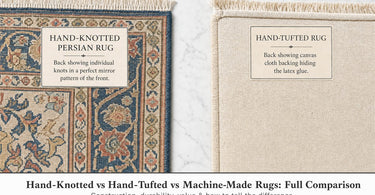
When shopping for a high-quality rug, you'll inevitably come across two terms that sound similar but represent vastly different products: hand knotted rug and hand tufted rug.
While both are made by hand, the construction methods, lifespan, and value are completely different. A hand-knotted rug is a generational heirloom that takes months to weave, while a hand-tufted rug is made quickly using a tool and glue. If you want to know if a hand knotted rug is worth it, or simply how to tell the difference, this guide covers everything you need to know.
Table of Contents
What is a Hand-Knotted Rug?
A hand knotted rug is the pinnacle of rug craftsmanship. It is made on a specially designed loom, where an artisan ties individual knots (usually wool or silk) around the warp threads to create the pile and pattern of the rug.
This process is incredibly labor-intensive. A single 8x10 hand-knotted rug can take anywhere from 6 to 12 months to complete, depending on the knot density (knots per square inch, or KPSI). Because there is no glue or backing used, these rugs are incredibly durable, often lasting for generations and becoming family heirlooms.
What is a Hand-Tufted Rug?
A hand tufted rug is made by punching strands of yarn through a canvas backing using a handheld tool called a tufting gun. Once the pattern is filled in, the rug is flipped over, and a layer of latex glue is applied to the back to hold the yarns in place. Finally, a protective cloth backing is glued over the latex.
Because this method is much faster—an 8x10 tufted rug can be made in a few days—hand-tufted rugs are significantly more affordable. However, the latex glue breaks down over time (usually within 5 to 10 years), causing the rug to shed, smell, or fall apart. They are great for budget-friendly decorating but are not investment pieces.
How to Tell the Difference (The 3 Tests)
If you're looking at a rug and aren't sure how it was made, you can easily figure it out using these three simple tests:
1. The Back Test
Flip the rug over and look at the back. If it is a true hand-knotted rug, the back will be a perfect mirror image of the front design, and you will be able to see the individual knots. If the back is covered by a canvas or cloth backing, it is a hand-tufted rug (the cloth is there to hide the glue).
2. The Fringe Test
Look at the fringe at the ends of the rug. On a hand-knotted rug, the fringe is actually the structural warp threads extending out from the foundation of the rug—it is an integral part of the rug itself. On a hand-tufted (or machine-made) rug, the fringe is usually sewn or glued on after the rug is finished purely for decoration.
3. The Flexibility Test
Try to fold the rug. A hand-knotted rug has no glue, so it is highly flexible and can be folded easily, much like a thick blanket. A hand-tufted rug is stiff and rigid because of the latex glue backing, and it will resist being folded.
Side-by-Side Comparison
| Feature | Hand-Knotted | Hand-Tufted |
|---|---|---|
| Lifespan | 50 to 100+ years | 5 to 10 years |
| Backing | Mirror image of front, visible knots | Canvas or cloth covering glue |
| Fringe | Structural (part of the rug) | Sewn or glued on |
| Value | Investment piece, retains value | Decor piece, depreciates |
| Shedding | Minimal to none | Often sheds heavily as glue degrades |
What About Machine-Made Rugs?
Machine made rugs are woven on power looms controlled by computers. They can be produced in a matter of hours, making them the most affordable option on the market. They are usually made from synthetic materials like polypropylene or polyester, though machine-made wool rugs do exist.
While machine-made rugs can look beautiful and are great for high-traffic or messy areas, they lack the unique character, durability, and value of a hand-knotted rug. You can identify a machine-made rug by looking at the back: the pattern will be visible, but the stitching will look perfectly uniform and grid-like, unlike the slightly irregular knots of a handmade rug.
"Many customers come to us frustrated because their expensive 'handmade' rug started falling apart and smelling like chemicals after three years. They didn't realize they bought a hand-tufted rug with latex glue. If you want a rug that lasts a lifetime, always verify that it is hand-knotted."
— Naheed Mir, Founder of RugKnots (Sourcing Rugs Since 1987)
Frequently Asked Questions
Is a hand-knotted rug worth the money?
Yes, if you view it as a long-term investment. A hand-knotted rug will outlast several hand-tufted or machine-made rugs, making it more cost-effective over a lifetime. They also hold their value and can be passed down as heirlooms.
Can you vacuum a hand-tufted rug?
Yes, but you should use a vacuum without a beater bar (or turn the beater bar off). The aggressive spinning brush can pull the yarns out of the latex glue backing, causing the rug to shed excessively and degrade faster.
Why does my hand-tufted rug smell?
The smell usually comes from the latex glue used to secure the yarns to the backing. As the glue ages or is exposed to moisture, it can off-gas and produce a burnt rubber or chemical odor. Hand-knotted rugs do not use glue and do not have this problem.
About RugKnots
RugKnots is a family-owned rug company based in Hagerstown, Maryland. Founded in 2010, we've spent over 14 years helping homeowners and designers find the right rug — from hand-knotted Persian heirlooms to durable machine-made everyday pieces. We hand-inspect every order before it ships, offer free U.S. shipping, and back every purchase with our 30-day return guarantee.
This article was written by our editorial team and reviewed for accuracy. Our writers work directly with our buyers and customer-experience team, who handle thousands of rug questions every year. If you have a question this article didn't answer, reach out — a real human will get back to you within one business day.