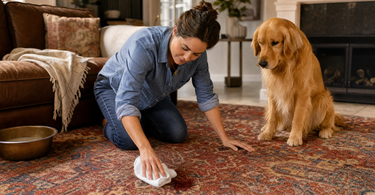
Pet accidents happen to every rug owner. The good news: if you act quickly and use the right method, most pet stains — urine, vomit, muddy paw prints — can be fully removed without damaging your rug. The bad news: if you use the wrong cleaner or wait too long, you can set the stain permanently and lock the odor into the fibers for good.
This guide covers fresh stains, dried and set-in stains, material-specific advice, and how to stop pets from returning to the same spot.
For general rug care tips, see our main Rug Care & Cleaning Guide →
In This Guide
- How to Remove Fresh Pet Urine
- How to Remove Dried or Old Urine Stains
- How to Remove Pet Vomit
- How to Remove Muddy Paw Prints
- Cleaning by Rug Material
- Enzyme Cleaners: What to Use and Why
- What Not to Use on Pet Stains
- Why Pets Return to the Same Spot (and How to Stop It)
- When to Call a Professional
- Frequently Asked Questions
How to Remove Fresh Pet Urine from an Area Rug
Blot Up Liquid Immediately
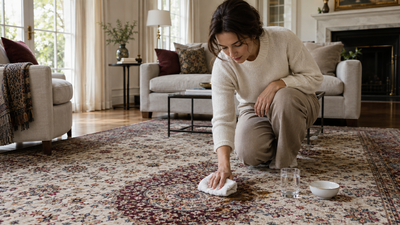
Blot up as much liquid as possible immediately using clean white paper towels or a cloth. Press firmly — never rub. Stand on the towels to apply maximum pressure and absorb liquid deep in the pile. Keep replacing towels until no more moisture transfers.
Apply Vinegar Solution
Mix one cup of cool water with one tablespoon of white vinegar and one teaspoon of mild dish soap. Apply with a cloth to the stained area, blotting gently from the outer edges inward. The vinegar neutralizes the ammonia in urine and begins breaking down the stain. Do not pour directly onto the rug.
Apply Enzyme Cleaner
Apply a pet enzyme cleaner following the product directions. This step is critical — enzyme cleaners break down the uric acid crystals that cause persistent odor. Regular soap and water cannot do this. Let the enzyme cleaner sit for the full recommended time (usually 10–15 minutes) before blotting.
Baking Soda Finish
Blot the area dry with clean cloths. Sprinkle baking soda generously over the treated area and leave for several hours (or overnight) to absorb any remaining odor. Vacuum up completely once dry.
Air Dry Completely
Allow the area to air dry completely before allowing pets or foot traffic back on it. Use a fan to speed drying. A damp area that is not fully dry will develop a musty smell and may attract the pet back to the same spot.
How to Remove Dried or Old Urine Stains
Dried urine is significantly harder to remove than fresh urine because the uric acid crystals have had time to bond with the fibers. The approach is different:
- Rehydrate the stain: Lightly mist the dried stain with cool water to reactivate the uric acid crystals. Do not soak — just dampen.
- Apply enzyme cleaner generously: Use more enzyme cleaner than you would for a fresh stain, and let it sit for 20–30 minutes. For very old stains, you may need to apply a second treatment.
- Cover and wait: After applying the enzyme cleaner, cover the area with a damp cloth and leave for up to an hour. This keeps the enzyme cleaner moist and active longer.
- Blot dry and apply baking soda: Blot the area dry, then apply baking soda and leave overnight. Vacuum up the next day.
- Check under UV light: A UV black light flashlight (available cheaply online) reveals dried urine stains that are invisible in normal light. This helps you find the full extent of the stain, which is often larger than the visible area.
How to Remove Pet Vomit from a Rug
Remove Solids First
Use a spoon or dull knife to scrape up as much solid material as possible. Work from the outside edges inward to avoid spreading. Do not press down — lift up and away from the rug surface.
Blot the Remaining Liquid
Blot remaining liquid with paper towels, pressing firmly. Replace towels until no more moisture transfers.
Apply Cleaning Solution
Apply a solution of cool water and mild dish soap, blotting gently from the edges inward. For vomit that contains bile (yellow staining), hydrogen peroxide diluted 1:3 with water can help — but test on a hidden area first, as it can bleach some rug dyes.
Apply Enzyme Cleaner
Follow with an enzyme cleaner to neutralize any remaining odor from the stomach acids. Let sit for 10–15 minutes, then blot dry.
Baking Soda and Dry
Sprinkle baking soda, leave for several hours, vacuum up. Air dry completely.
How to Remove Muddy Paw Prints
The most important rule with mud: wait for it to dry completely before cleaning. Scrubbing wet mud pushes it deeper into the fibers and spreads it further. Let it dry fully, then:
- Break apart the dried mud with your fingers or a stiff brush.
- Vacuum up as much dried mud as possible.
- Treat any remaining residue or staining with a mild soap-and-water solution, blotting with a cloth.
- Rinse with a damp cloth and blot dry.
Cleaning Pet Stains by Rug Material
The rug's material affects which cleaning methods are safe:
| Material | Safe for Pet Stain Cleaning | Special Considerations |
|---|---|---|
| Polypropylene / synthetic | All methods above | Most forgiving — resists staining and odor absorption |
| Wool | Blotting, enzyme cleaner, baking soda | Avoid hot water, vinegar (acidic), and excessive moisture. See our Wool Rug Guide |
| Cotton | All methods above | Cotton absorbs odors more readily — enzyme cleaner is especially important |
| Jute / sisal | Blotting only — minimal moisture | Natural fibers are extremely sensitive to water — excess moisture causes rot and mold. Professional cleaning recommended for serious accidents |
| Persian / hand-knotted | Blotting only — professional cleaning for anything serious | High-value rugs should be professionally cleaned for any significant pet accident |
Enzyme Cleaners: What to Use and Why
Enzyme cleaners are the single most important product for pet stain removal. They work by producing enzymes that break down the organic compounds in urine, vomit, and feces — specifically the uric acid crystals that cause persistent odor. Regular soap and water cannot break down these compounds; they can only dilute and spread them.
What to look for in an enzyme cleaner:
- Specifically labeled for pet urine or pet odor (not just general stain remover)
- Contains live bacterial cultures or enzymatic compounds
- No added fragrances that just mask odor without eliminating it
How to use it correctly: Apply generously to the full affected area (including a few inches beyond the visible stain). Let it sit for the full recommended dwell time — do not rush this step. The enzymes need time to work. Blot dry after the dwell time; do not rinse with water immediately, as this stops the enzymatic reaction.
What Not to Use on Pet Stains
| Product | Why to Avoid |
|---|---|
| Bleach | Discolors and permanently damages rug fibers and dyes |
| Ammonia-based cleaners | The ammonia smell mimics urine and actually attracts pets back to the same spot |
| Steam cleaners on urine stains | Heat sets the stain and bonds the odor permanently into the fibers |
| Scrubbing or rubbing | Spreads the stain, damages pile fibers, and pushes the stain deeper |
| Baking soda alone | Absorbs surface odor only — does not break down uric acid crystals causing deep odor |
| Vinegar alone on old stains | Helps with fresh stains but is not strong enough to neutralize dried uric acid crystals |
Why Pets Return to the Same Spot (and How to Stop It)
Pets are drawn back to spots where they have previously urinated because they can smell residual urine odor — even when you cannot. Their sense of smell is far more sensitive than ours, and if any uric acid crystals remain in the fibers, the spot will continue to signal "this is a bathroom" to your pet.
How to break the cycle:
- Use an enzyme cleaner thoroughly — this is the only way to fully eliminate the scent signal, not just mask it
- After cleaning, place a citrus-scented deterrent spray around the area (pets dislike citrus)
- Temporarily place an upside-down carpet runner or aluminum foil over the spot — pets avoid walking on these textures
- For persistent re-soiling, consult a veterinarian — it may indicate a medical issue (UTI, anxiety, territorial marking) rather than a training problem
When to Call a Professional Rug Cleaner
DIY cleaning handles most pet accidents effectively, but some situations require professional intervention:
- Stain has soaked through to the backing or padding — the odor source is below the surface and cannot be reached with surface cleaning
- Multiple accidents in the same area over time — layers of dried urine require centrifugal extraction to fully remove
- Wool, silk, or hand-knotted rugs — these materials require specialist handling to avoid damage
- Persistent odor after two DIY treatments — if the smell returns after the rug dries, the source is deeper than surface cleaning can reach
Frequently Asked Questions
- If pet accidents are frequent, consider a washable area rug → that goes straight in the washing machine. See our Machine Washing Guide →
- For all-around rug care tips, visit our Rug Care & Cleaning Hub →
- Not sure which rug is best for pets? Read our Complete Rug Buying Guide →
About RugKnots
RugKnots is a family-owned rug company based in Hagerstown, Maryland. Founded in 2010, we've spent over 14 years helping homeowners and designers find the right rug — from hand-knotted Persian heirlooms to durable machine-made everyday pieces. We hand-inspect every order before it ships, offer free U.S. shipping, and back every purchase with our 30-day return guarantee.
This article was written by our editorial team and reviewed for accuracy. Our writers work directly with our buyers and customer-experience team, who handle thousands of rug questions every year. If you have a question this article didn't answer, reach out — a real human will get back to you within one business day.