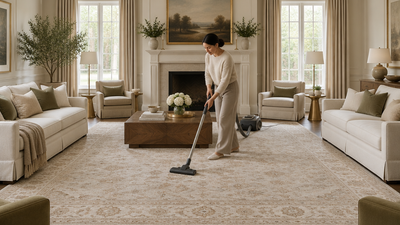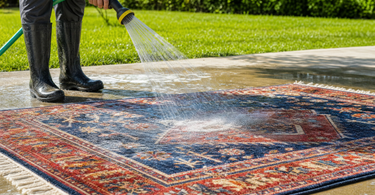
Can you put an area rug in the washing machine? Sometimes yes — and sometimes absolutely not. Getting this wrong can shrink, warp, or permanently damage your rug. This guide tells you exactly which rugs are safe to machine wash, how to read the care label, the correct machine settings to use, and how to dry the rug properly afterward.
For general rug care tips, see our main Rug Care & Cleaning Guide →
In This Guide
Which Area Rugs Are Machine Washable?
✅ Safe to machine wash:
- Rugs explicitly labeled "machine washable" on the care tag
- Flatweave cotton rugs
- Small synthetic (polypropylene, nylon) rugs
- Washable area rugs designed for machine washing
- Small accent rugs under 4x6 with no rubber backing (check the label)
❌ Never machine wash:
- Hand-knotted rugs (wool, silk, Persian, Oriental)
- Wool rugs (unless explicitly labeled machine-safe)
- Jute, sisal, seagrass, or any natural fiber rug
- Rugs with a rubber or latex backing
- Shag rugs (long pile tangles in the drum)
- Any rug larger than your machine can comfortably hold
How to Read the Care Label
The care label is the definitive guide for your specific rug. It is usually sewn to the back corner or edge. Here is what the common symbols mean:
| Symbol / Text | Meaning |
|---|---|
| Washing tub with water | Machine washable — the number inside indicates maximum water temperature in Celsius |
| Washing tub with hand | Hand wash only — do not machine wash |
| Washing tub with X through it | Do not wash with water — dry clean only |
| "Machine washable" text | Safe to machine wash per the instructions given |
| "Spot clean only" | Do not submerge — clean stains individually with a damp cloth |
| "Dry clean only" | Professional cleaning required — no water |
Step-by-Step: How to Machine Wash an Area Rug
Check the Care Label
This is non-negotiable. If the label says "dry clean only," "spot clean only," or shows a washing tub with an X through it, do not machine wash. Proceeding against the label voids any warranty and risks permanent damage.
Shake and Vacuum First
Take the rug outside and shake out loose dirt. Vacuum both sides to remove surface debris before washing. Putting a heavily soiled rug directly in the machine spreads dirt through the wash water and can clog the machine's drain.
Check It Fits Loosely
The rug should fit loosely in the drum — not crammed in. You should be able to push it to one side and see space on the other. Overloading stresses both the machine and the rug, and prevents proper rinsing. For rugs larger than 5x7, a commercial washing machine at a laundromat is needed.
Set the Machine Correctly
Cold water. Gentle or delicate cycle. Low or no spin speed if possible. Hot water and high spin speeds cause shrinkage, color bleeding, and backing damage. See the settings table below for details.
Use the Right Detergent
A mild liquid detergent — not powder, not bleach, not fabric softener. Use half the normal amount. Rugs hold detergent in their fibers and are difficult to fully rinse, so less is better. Fabric softener leaves a residue that attracts dirt.
Wash Alone
Do not mix with other laundry. The rug needs space to move freely, and its dirt and dye should stay separate from your clothing.
Run an Extra Rinse Cycle
After the main wash, run an additional rinse cycle without detergent. This removes any remaining soap residue from the fibers, which can cause the rug to feel stiff or attract dirt faster if left in.
Dry Properly
See the drying section below. This step is where most people make mistakes that damage the rug or cause mildew.
Machine Settings Explained
| Setting | Recommended | Why |
|---|---|---|
| Water temperature | Cold (30°C / 86°F or below) | Hot water shrinks fibers and causes color bleeding |
| Cycle type | Gentle / Delicate | Less agitation protects pile and backing |
| Spin speed | Low or no spin | High spin can distort the rug shape and damage rubber backing |
| Detergent | Mild liquid, half dose | Powder doesn't dissolve fully; excess detergent leaves residue |
| Fabric softener | Never | Leaves a coating that attracts dirt and reduces pile texture |
| Bleach | Never (unless label permits) | Destroys fibers and causes permanent color loss |
Home Machine vs. Laundromat: Which to Use?
The size of your rug determines where it should be washed:
| Rug Size | Where to Wash |
|---|---|
| 2x3, 2x4, 3x5, 4x6 | Home washing machine (most standard machines handle these) |
| 5x7, 5x8 | Home machine if it fits loosely; laundromat if it's cramped |
| 6x9, 8x10, 9x12 | Commercial laundromat machine (front-loader, large capacity) |
| Larger than 9x12 | Professional rug cleaning — too large for any consumer machine |
Commercial front-loading machines at laundromats are gentler than top-loading agitator machines and have much larger drums. For rugs in the 6x9 to 9x12 range, a laundromat's large-capacity machine (typically 60–80 lb capacity) is the right choice.
How to Dry a Rug After Washing
Improper drying is the most common cause of post-wash damage. A damp rug develops mildew within 24–48 hours if not dried properly.
Option 1 — Air dry flat: Lay the rug flat on a clean outdoor surface or large drying rack in a shaded area. Elevate on a rack if possible to allow airflow underneath. Flip halfway through drying. This is the safest method for all machine-washable rugs.
Option 2 — Tumble dry (if label permits): Use low heat only. Add two or three clean tennis balls or dryer balls to help fluff the pile and prevent clumping. Check every 20 minutes and remove promptly when dry. Never use high heat.
Option 3 — Line dry: Drape over two parallel rails or a sturdy clothesline so air circulates on both sides. Avoid draping over a single line — the fold line can create a permanent crease.
Troubleshooting: What Went Wrong
| Problem | Likely Cause | Fix |
|---|---|---|
| Rug shrunk | Hot water or high spin speed | Lay flat while damp and gently stretch back to shape; use cold water next time |
| Colors bled | Hot water or incompatible dyes | Rinse with cold water immediately; test a corner before washing next time |
| Rug came out wrinkled | Crammed into machine or high spin | Lay flat while damp and smooth out; use low spin next time |
| Backing peeled or cracked | Hot water or high heat drying | Backing damage is usually permanent; use cold water and air dry only |
| Rug smells musty after washing | Not dried quickly or completely enough | Rewash and dry immediately in a well-ventilated area; use a fan to speed drying |
| Pile feels stiff | Too much detergent or insufficient rinsing | Run an extra rinse cycle; use less detergent next time |
Frequently Asked Questions
- Browse our full selection of washable area rugs → designed for machine washing.
- For stain removal tips, see our guide on How to Get Pet Stains Out of a Rug →
- Cleaning a wool rug? Read our Wool Rug Care Guide →
- For all-around rug care, visit our Rug Care & Cleaning Hub →
About RugKnots
RugKnots is a family-owned rug company based in Hagerstown, Maryland. Founded in 2010, we've spent over 14 years helping homeowners and designers find the right rug — from hand-knotted Persian heirlooms to durable machine-made everyday pieces. We hand-inspect every order before it ships, offer free U.S. shipping, and back every purchase with our 30-day return guarantee.
This article was written by our editorial team and reviewed for accuracy. Our writers work directly with our buyers and customer-experience team, who handle thousands of rug questions every year. If you have a question this article didn't answer, reach out — a real human will get back to you within one business day.