The word "vintage" gets thrown around loosely in rug retail. A rug made in 2015 with a distressed wash finish can look decades older than it is. If you're paying a premium for something genuinely old, here's what to actually check.
Start With the Back of the Rug
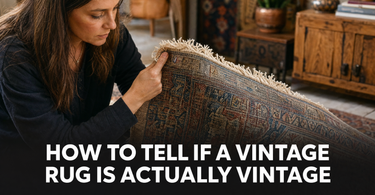
Flip the rug over. The back tells you more than the front.
- Knot visibility: On a hand-knotted rug, you should see individual knots — tight, slightly irregular, with variation across the field. Machine-made rugs have perfectly uniform loops and a latex or fabric backing. A genuine vintage hand-knotted rug never has a flat, rubbery back.
- Foundation color: On older rugs, the warp and weft threads (the structural grid the knots tie onto) will have aged to an ivory, tan, or grey tone. Bright white cotton foundation is a sign of a newer piece.
- Wear through to foundation: On very old rugs, you'll often see the foundation exposed in high-traffic zones like the center field. This is normal and expected — not necessarily a dealbreaker, depending on the degree.
Read the Dye Fading
Natural dyes — made from madder root, indigo, pomegranate rind, and walnut — fade in a specific way over decades. They soften and develop what dealers call abrash: subtle horizontal bands of slightly different color intensity caused by dye-lot variation across the wool. This isn't a flaw. It's a fingerprint of handmade construction and real aging.
Synthetic dyes, introduced broadly after the 1870s and dominant by the 1920s, fade differently — they can bleed, streak, or hold color in an unnaturally uniform way even as the pile wears down. Chrome dyes (common in mid-20th century rugs) produce very even, stable color that doesn't shift with age.
One useful test: dampen a white cloth and rub it firmly on a colored section. Some color transfer is normal. Heavy, immediate bleed in a single color suggests a low-quality synthetic dye job, sometimes used in modern pieces trying to pass as vintage.
Knot Count and Pile Height
Knot count (KPSI — knots per square inch) is a quality indicator but not a date indicator on its own. A fine Tabriz from 1950 might have 200+ KPSI. A tribal Kazakh from 1890 might have 40. Both are genuinely old.
What pile height does tell you is use history. A rug with worn, compressed pile in the center and fuller pile at the border has actually been walked on. A "vintage" rug with even pile height across the entire surface hasn't been lived in — it's either stored its whole life (possible) or it's not actually old (more likely).
Wear Patterns That Make Sense
Authentic age produces wear in logical places:
- Center field — where people walk
- In front of furniture — chairs, sofas, doorways
- Along fold lines, if the rug was stored rolled or folded
Distressed rugs produced for the mass market are washed with chemicals and mechanically abraded to create the look of age. The tell: the distressing is even across the whole rug, including areas that would never realistically wear (the corners, the outer border). Real wear is uneven and logical.
What Dealers Actually Check
When an experienced dealer evaluates a rug's age, they're looking at:
- Fringe: Original fringe is a continuation of the warp threads — it's integral to the rug's structure. Added fringe is sewn on and usually pulls away easily. Old original fringe is often worn, knotted, or patched — it doesn't look pristine.
- Selvedge (side cords): The edges. Hand-finished selvedges on old rugs are often re-wrapped over time as they wear. Machine-perfect overcasting on the edge of a "vintage" rug is a red flag.
- Smell: Old wool has a distinct lanolin-and-dust smell, especially on the back. Chemical wash smell — like dry-cleaning fluid or bleach — suggests heavy processing to simulate age.
- Provenance: A rug with a paper label from a mid-century retailer, an estate sale receipt, or a dated family photo is worth more confidence than a rug with a story and no documentation.
The Bottom Line
No single indicator is definitive. But a genuinely vintage rug will pass on most counts: natural dye character, logical wear, integral fringe, aged foundation, and hand-knotted construction with visible irregularity. The more boxes it checks, the more confident you can be.
If a seller can't flip the rug over to show you the back, walk away.
Related Articles
- Vintage Rugs in Modern Homes: How to Style Them Without It Looking Dated
- Best Vintage Rug Styles to Buy Right Now: Oushak, Beni Ourain, Kilim, Persian
- How Long Do Wool Rugs Last? What to Expect
About RugKnots
RugKnots is a family-owned rug company based in Hagerstown, Maryland. Founded in 2010, we've spent over 14 years helping homeowners and designers find the right rug — from hand-knotted Persian heirlooms to durable machine-made everyday pieces. We hand-inspect every order before it ships, offer free U.S. shipping, and back every purchase with our 30-day return guarantee.
This article was written by our editorial team and reviewed for accuracy. Our writers work directly with our buyers and customer-experience team, who handle thousands of rug questions every year. If you have a question this article didn't answer, reach out — a real human will get back to you within one business day.