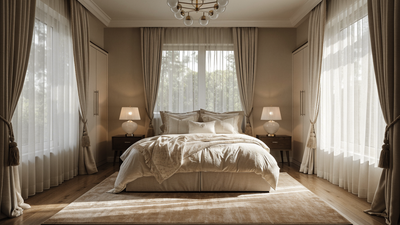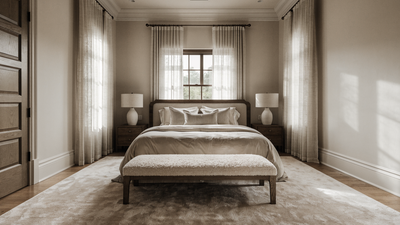




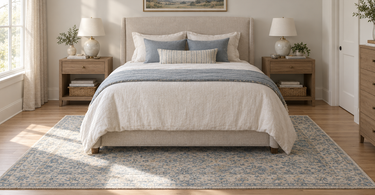
Quick answer: position a bedroom rug under the lower two-thirds of the bed, running horizontally (the long side across the bed), with its top edge stopping a few inches in front of the nightstands and 18 to 24 inches of rug showing on both sides and at the foot. Center it on the bed, not the room, and keep at least 12 inches of bare floor at the walls. For most beds that means an 8x10 under a queen and a 9x12 under a king.
- Orientation: horizontal for queen and king, so the rug spans the bed with even sides.
- Top edge: 2 to 6 inches in front of the nightstands, or fully under them if the rug is big enough.
- Exposure: 18 to 24 inches on each side and at the foot (24 to 36 in a large room).

How to Position an Area Rug in a Bedroom, Step by Step
- Measure the bed and nightstands. Note the mattress width (queen 60 in, king 76 in) and how deep the nightstands are (usually 16 to 22 in).
- Pick the placement method from the three below, based on rug size and room size.
- Clear the floor and lay the rug pad first, cut 1 to 2 inches smaller than the rug on every side.
- Center the rug on the bed. Measure from the mattress edge to the rug edge on both sides until the numbers match.
- Set the top edge. Slide the rug up until it sits 2 to 6 inches in front of the nightstands (or under them for full coverage), then square it to the bed frame.
- Check the foot. You want at least 18 inches of rug past the footboard, more if a bench sits there.
- Test the doors. Swing every closet and bedroom door; if one catches, the rug needs to move or the pile needs to drop.
3 Ways to Place a Rug Under a Bed

1. Full coverage under the bed and nightstands
The rug runs under everything: bed, both nightstands, and 12 to 24 inches beyond them on each side. It is the most finished look and the one designers use in large rooms. The catch is width. A queen with two 24-inch nightstands is 108 inches across, so you need a rug at least 132 inches wide, which means a 9x12 placed horizontally. A king with nightstands is 124 inches across and needs a 10x14. Push the rug all the way to the headboard wall or leave 6 to 12 inches of floor behind the nightstands; both are fine.
2. Lower two-thirds, in front of the nightstands
The default for most bedrooms. The rug starts 2 to 6 inches in front of the nightstands and runs under the bottom two-thirds of the bed and 18 to 24 inches past the foot. The nightstands stay on the bare floor, so they sit level and the rug can be one size smaller than full coverage: an 8x10 under a queen, a 9x12 under a king. Because the rug is centered on the bed alone, it also works with mismatched or single nightstands.
3. Starting mid-bed, or at the foot (with a bench)
In a small room, or on a budget, the rug can start halfway down the bed and extend past the foot, where a bench or storage ottoman sits on it. A 5x8 placed horizontally under the lower third of a queen shows 18 inches on each side and about 30 inches at the foot, enough for an 18-inch bench with rug beyond it. A 6x9 does the same under a king. The rug reads as a landing zone rather than a frame for the bed, which suits modern and minimalist rooms.
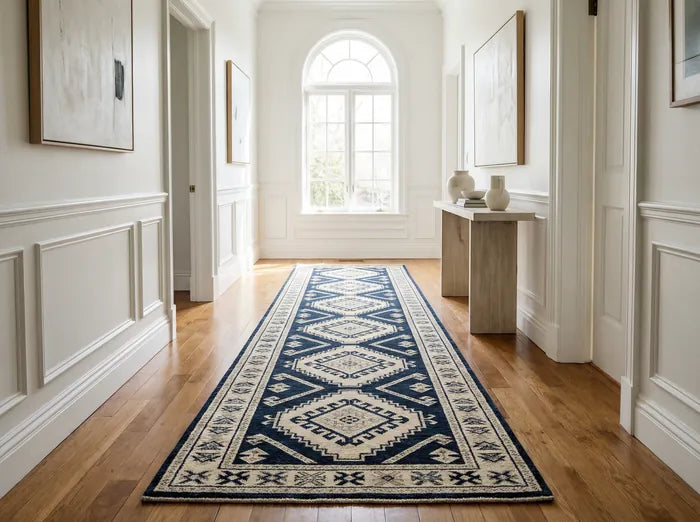
Runners on both sides of the bed

When the bed sits close to the walls or the floor under it is not worth covering, use two matching runners (2'6" x 8' is the standard) parallel to the bed, from the nightstand to just past the foot. Leave 4 to 6 inches between the runner and the bed frame so the edge does not curl under the bed. A single runner on the open side works for a bed pushed against a wall.
A rug at the foot of the bed only
A 4x6 or 5x8 laid horizontally across the foot, with 6 to 12 inches tucked under the bed, gives you softness where you dress and a spot for a bench. It is the cheapest option and the least anchored; it works best in rooms with wall-to-wall carpet underneath.
Which Way Should a Rug Go Under a Bed? Horizontal vs Vertical
Horizontal means the rug's long side runs across the width of the bed, so the rug is wider than it is deep. This is the right orientation for almost every bed from full size up, because it puts the extra length where you step out: on the sides. An 8x10 placed horizontally under a queen shows 30 inches of rug on each side; the same rug placed vertically shows only 18, and its 120-inch length runs 40 inches past the foot of an 80-inch bed, more than most rooms can spare.
Vertical (the long side parallel to the bed) has two uses: long, narrow rooms where you want the rug to reach a bench or dresser at the foot, and twin beds, where a 5x8 vertical alongside a single bed becomes a wide bedside landing. When in doubt, go horizontal.
How Far Should a Rug Extend Past the Bed?
The working range is 18 to 24 inches on the sides and at the foot. Under 18 inches the rug looks like it is hiding under the bed; over 36 inches and it starts to read as wall-to-wall carpet. In a large primary bedroom, 24 to 36 inches looks more generous. Use the table below to see how much rug each size actually shows once it is centered under a bed. Mattress widths: twin 38 in, full 54 in, queen 60 in, king 76 in, California king 72 in.
| Bed (mattress size) | Rug, placed horizontally | Rug showing on each side | Placement |
|---|---|---|---|
| Twin (38 x 75 in) | 4x6 (72 in wide) | 17 in | Lower half of the bed |
| Twin (38 x 75 in) | 5x8 (96 in wide) | 29 in | Lower two-thirds, or vertical alongside |
| Full (54 x 75 in) | 5x8 (96 in wide) | 21 in | Lower two-thirds |
| Full (54 x 75 in) | 6x9 (108 in wide) | 27 in | In front of the nightstands |
| Queen (60 x 80 in) | 5x8 (96 in wide) | 18 in | Mid-bed only; small rooms |
| Queen (60 x 80 in) | 6x9 (108 in wide) | 24 in | Lower two-thirds; about 16 in at the foot |
| Queen (60 x 80 in) | 8x10 (120 in wide) | 30 in | In front of the nightstands (standard) |
| Queen (60 x 80 in) | 9x12 (144 in wide) | 42 in | Full coverage under nightstands |
| King (76 x 80 in) | 8x10 (120 in wide) | 22 in | In front of the nightstands; the minimum |
| King (76 x 80 in) | 9x12 (144 in wide) | 34 in | In front of the nightstands (standard) |
| King (76 x 80 in) | 10x14 (168 in wide) | 46 in | Full coverage under nightstands |
| Cal king (72 x 84 in) | 9x12 (144 in wide) | 36 in | In front of the nightstands |
Two numbers worth noticing. An 8x10 under a king shows 22 inches per side, so it works but never reaches the 24-inch mark; a 9x12 is the comfortable choice, and our 9x12 under a king bed guide shows the layouts. And a 6x9 under a queen, started in front of the nightstands, leaves only about 16 inches at the foot, which is why designers step up to the 8x10. For the full size math by bed, see the bedroom rug size guide.
Placing a Rug With One or No Nightstands
Center the rug on the bed, never on the bed-plus-nightstand group. With one nightstand, use the in-front-of-nightstands method so the rug clears it, or go big enough that the nightstand sits fully on the rug with equal exposure on the empty side. With no nightstands, you are free to slide the rug up to within 6 to 12 inches of the headboard wall; a rug that starts at the pillow line and shows 24 inches on each side is the cleanest look. Never let a nightstand straddle the rug edge with two legs on and two off; it rocks, and it looks like a mistake.
Rug Placement When the Bed Is Against a Wall
A bed pushed into a corner or against a side wall cannot have a centered rug. Two options work. Run the rug from the wall outward so it extends 18 to 24 inches past the open side and past the foot; the rug is off-center in the room but centered on the way you use the bed. Or skip the under-bed rug and lay a runner along the open side. For a daybed or a bed on the diagonal in an odd-shaped room, angle the rug with the bed rather than the walls.
Rug Placement in Large Bedrooms: The Island Effect and Walkways

In a room over 14x16 feet, a too-small rug turns the bed into an island floating in bare floor. Size up to a 9x12 or 10x14 so the rug covers the bed and nightstands and leaves 24 inches or so of floor at the walls; wall-to-wall coverage flattens the room. Keep walkways at least 30 inches wide between the rug edge and dressers or closets, and if the room has a seating area or a desk, give it its own smaller rug rather than stretching one rug to reach everything. A 12x15 is the largest standard size before custom.
Round Rug Under a Bed
A round rug softens a boxy room and works well under a queen in a square bedroom. Center it under the lower two-thirds of the bed so the curve shows on both sides and at the foot. An 8-foot round under a queen shows 18 inches at the widest point on each side; under a king, a 9- or 10-foot round is the minimum. Because the sides taper, round rugs pair best with the in-front-of-nightstands method and a bed without a footboard.
How to Measure Your Bedroom Before Placing a Rug

- Minimum rug width = mattress width + 36 to 48 inches (18 to 24 in per side). Queen: 96 to 108 in, so an 8x10 placed horizontally (120 in) is comfortable.
- Rug depth = the part of the bed you want covered + 18 to 24 inches at the foot. For a queen started in front of the nightstands, about 56 inches of bed plus 24 at the foot is 80 inches; an 8x10's 96-inch depth covers it.
- Maximum rug = room length and width minus 24 inches each (12 in of floor at each wall).
- Tape it out. Mark the rug with painter's tape, check door swings, dresser drawers and closet doors, and live with it for a day before ordering.
Choosing Pile Height and Material for a Bedroom Rug
Bedrooms are low-traffic and barefoot, so this is the one room where a plusher pile makes sense: a half-inch to one-inch wool or wool-blend pile is soft on cold mornings and hides footprints. Keep the pile under half an inch where doors swing over the rug or where an office chair rolls, and avoid shag under bed legs, which crush it. Wool resists stains and holds up for decades; washable rugs suit kids' rooms and pets; jute and sisal are too coarse for bedsides. Always add a pad: felt for cushioning under a large rug the bed holds down, felt-and-rubber for a 5x8 or runner that nothing anchors. Our rug pad guide covers thickness by floor type.
Common Bedroom Rug Placement Mistakes
| Mistake | What it looks like | Fix |
|---|---|---|
| Rug too small | Rug ends at or just past the mattress edge | Size up one step: 5x8 to 8x10, 8x10 to 9x12 |
| Rug placed vertically | Lots of rug at the foot, a sliver on the sides | Turn it horizontal |
| Nightstand straddling the edge | Nightstand rocks, rug edge lifts | Move the rug 2 to 6 in in front, or go big enough to cover |
| Rug centered on the room | Uneven exposure on each side of the bed | Center on the mattress |
| Rug touching the walls | Reads as carpet, room looks smaller | Leave 12 to 24 in of floor at the walls |
| No pad | Runners slide, corners curl | Add a pad cut 1 to 2 in smaller than the rug |
| Runner too short | Ends before the foot of the bed | Use an 8-ft runner for a queen or king |
Frequently Asked Questions
Should a rug go all the way under the bed?
Which way should a rug go under a bed?
How far should a rug extend past the bed?
Do nightstands go on the rug?
What size rug goes under a queen bed?
Can I put a rug in front of the bed instead of under it?
About RugKnots
RugKnots is a family-owned rug company in Hagerstown, Maryland, importing and selling hand-knotted rugs since 1987. We hand-inspect every order, offer free U.S. shipping and a 30-day return guarantee. Questions? Reach out and a real person will reply within one business day.