There is a reason interior designers are obsessed with vintage rugs. A mass-produced, machine-made rug can look nice, but it will never have the soul, the history, or the unmistakable patina of a rug that has been walked on for fifty years. Vintage rugs do not just cover a floor; they tell a story.
However, buying a vintage rug can be intimidating. How do you know if you are getting a genuine antique or a clever fake? What is the difference between a vintage Persian and a vintage Oushak? And what exactly is an "overdyed" rug? In this ultimate guide, we will answer all of your questions and show you exactly how to buy, style, and care for vintage area rugs.
Table of Contents
What Makes a Rug "Vintage"?
In the rug industry, age determines the classification. A rug is considered vintage if it is between 30 and 99 years old. Once a rug reaches 100 years of age, it officially becomes an antique. Anything less than 30 years old is considered modern or contemporary.
True vintage rugs are always hand-knotted. They were woven on traditional looms by artisans in countries like Iran, Turkey, Afghanistan, and India. The natural fading (or "patina") you see on a vintage rug cannot be perfectly replicated by a machine; it is the result of decades of sunlight, foot traffic, and natural oxidation of the vegetable dyes.
Popular Vintage Styles (Persian vs. Oushak)
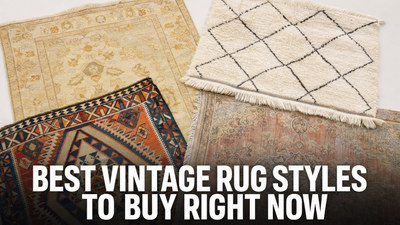
While there are hundreds of regional weaving styles, the two most popular categories of vintage rugs are Persian and Oushak.
| Style | Origin | Visual Characteristics |
|---|---|---|
| Vintage Persian (Heriz, Tabriz) | Iran | Dense, intricate floral or geometric patterns. Usually features a central medallion. Rich reds, deep blues, and dark navy colors. |
| Vintage Oushak | Turkey | Larger, more open scale geometric and floral motifs. Much lighter, pastel color palettes (apricot, soft blue, ivory, sage green). |
If your home is traditional or moody, a vintage Persian is the perfect anchor. If your home is light, bright, coastal, or modern transitional, a vintage Oushak will blend in seamlessly.
The Overdyed Rug Trend Explained
You have likely seen vintage overdyed rugs in high-end design magazines. But what are they?
Overdyeing is a brilliant recycling process. When a vintage rug is severely worn, stained, or has an outdated color palette, it is first sheared down to a very low pile. Then, the rug is bleached to remove its original colors. Finally, it is submerged in a vat of vibrant, modern dye (such as hot pink, emerald green, or deep indigo).
The result is a stunning juxtaposition: the ghost of the traditional 100-year-old pattern is still visible beneath a bold, contemporary wash of color. Overdyed rugs are the perfect way to inject vibrant color into a modern, minimalist space while retaining the durability of a hand-knotted wool foundation.
How to Buy a Genuine Vintage Rug
The market is flooded with machine-made "vintage-style" rugs that are printed to look old. Here is how to ensure you are buying the real thing:
- Check the Back: The back of a genuine hand-knotted vintage rug will be an exact mirror image of the front. You should be able to see every individual knot. If there is a canvas or plastic backing, it is a modern fake.
- Look for Imperfections: Human hands make mistakes. A true vintage rug will have slight irregularities in the pattern, and the borders might not be perfectly straight. This is a sign of authenticity, not poor quality.
- Check the Fringe: On a genuine vintage rug, the fringe is the actual skeleton (warp threads) of the rug extending out the ends. If the fringe looks like it was sewn or glued onto the edge as an afterthought, it is machine-made.
"A vintage rug is the only piece of decor you can buy that has already proven it can survive for 50 years. When you buy a hand-knotted vintage piece, you aren't just decorating a room; you are becoming the next steward of a piece of art."
— Naheed Mir, Founder of RugKnots (Sourcing Rugs Since 1987)
Frequently Asked Questions
Are vintage rugs safe for high-traffic areas?
Absolutely. Remember, these rugs have already survived decades of use. Because they are made of hand-knotted wool, they are incredibly durable. Just be sure to use a high-quality rug pad to prevent slipping and protect the fibers.
How do you clean a vintage rug?
You can vacuum them regularly (using suction only, no beater bar). For spills, blot immediately with a clean cloth and club soda. For deep cleaning, you must send them to a professional rug cleaner who specializes in hand-washing. Never use chemical carpet cleaners or steam cleaners.
Do vintage rugs smell?
A properly washed vintage rug should not smell. If you buy a rug and it has a musty odor, it means it was not professionally cleaned before being sold. Leaving it in direct sunlight for a few hours can help neutralize mild odors.
Why are vintage rugs so thin?
Vintage rugs are thin because the pile (the fuzzy top layer) has been worn down by decades of foot traffic. Many dealers will also intentionally shear a vintage rug down to a low pile to even out the wear and highlight the underlying pattern.
Keep Exploring
Bring a piece of history into your home by browsing our curated collection of authentic Vintage Area Rugs and vibrant Overdyed Rugs.
Related Buying Guides
About RugKnots
RugKnots is a family-owned rug company based in Hagerstown, Maryland. Founded in 2010, we've spent over 14 years helping homeowners and designers find the right rug — from hand-knotted Persian heirlooms to durable machine-made everyday pieces. We hand-inspect every order before it ships, offer free U.S. shipping, and back every purchase with our 30-day return guarantee.
This article was written by our editorial team and reviewed for accuracy. Our writers work directly with our buyers and customer-experience team, who handle thousands of rug questions every year. If you have a question this article didn't answer, reach out — a real human will get back to you within one business day.