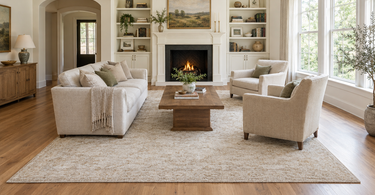
Quick answer: To place a rug in a living room, center it on the seating group (not the room) and run it parallel to the sofa. Then check four measurements:
- At least the front legs of the sofa and every chair sit 3 to 6 inches onto the rug.
- The rug extends 6 to 8 inches past each end of the sofa.
- 12 to 18 inches of bare floor shows between the rug and the walls (8 inches minimum in a small room).
- Walkways of 30 to 36 inches stay either fully on the rug or fully off it.
Most living rooms need an 8x10; rooms where all the furniture sits on the rug need a 9x12 or larger.

A rug does two jobs in a living room. It pulls separate pieces of furniture into one conversation area, and it frames that area against the rest of the floor. Get the placement wrong and even an expensive rug looks like it was dropped in by accident. The good news is that rug placement follows a handful of simple, measurable rules. Below are those rules, the three layouts designers rely on, how to handle sectionals, open-plan rooms and small apartments, and the mistakes we see most often in customer photos.
The Golden Rules of Living Room Rug Placement
Whatever layout you choose, these rules keep the room balanced:
- Anchor with the front legs at minimum. Every main seat should touch the rug with at least its front legs, 3 to 6 inches in. A sofa that sits entirely off the rug while the chairs sit on it looks disconnected.
- Center on the furniture, not the room. If the seating is pushed toward the fireplace, the rug follows the seating. A rug centered in the room with the sofa hanging off one side is a common misstep.
- Run it parallel to the sofa. The long side of a rectangular rug should run the same direction as the sofa.
- Keep an even border. Aim for the same amount of floor showing on opposite sides of the rug, even if the front and back borders differ.
- Use a rug pad. A pad stops creeping and buckling, keeps corners flat and protects the floor. Our rug pad guide covers which type to use on hardwood, tile or carpet.
How Far Should a Rug Extend Past the Sofa?
Let the rug run 6 to 8 inches past each end of the sofa, and ideally past any end tables too. As a formula: rug length should be at least the sofa length plus 12 to 16 inches. An 84-inch sofa therefore needs a rug that is at least 96 to 100 inches long on that side. A 5x8 laid lengthwise just manages it; an 8x10, with its 120-inch side along the sofa, does it comfortably. If the rug is shorter than the sofa, the sofa looks as though it is balancing on a bath mat.
How Much Floor Should Show Around the Rug?
In an average living room, leave 12 to 18 inches of floor between the rug and the walls. In a small room, 8 to 12 inches still looks deliberate. In a large room, 18 to 24 inches is fine. The only time a rug should come within a few inches of the wall is in wall-to-wall-style layering or in a very narrow space, because a thin strip of floor around the edge makes the rug look like carpet that did not quite fit.
3 Core Rug Layouts: All Legs On, Front Legs Only, Floating
Almost every well-placed living room rug follows one of these three layouts. The right one depends on your room size, your furniture and your budget.

1. All Legs On
The rule: every leg of the sofa, chairs and coffee table sits on the rug, with at least 6 inches of rug behind the back legs so the furniture does not teeter on the edge. Keep 12 to 18 inches of floor around the rug.
Rug size: 9x12 for a sofa, coffee table and two chairs; 10x14 or larger for big rooms or long sofas. An 8x10 only manages all legs on with a loveseat and one or two compact chairs.
Best for: large living rooms, open-plan spaces where the rug has to define a zone, and formal rooms.
Common mistake: buying an 8x10 for this layout in a large room. The furniture ends up crowded onto the rug with the back legs hanging off the edge.
2. Front Legs Only
The rule: the front legs of the sofa and chairs rest 3 to 6 inches onto the rug and the back legs sit on the floor. The coffee table sits fully on the rug.
Rug size: 8x10 for most living rooms (roughly 11x14 to 14x16 feet); 6x9 in smaller rooms with a sofa under 84 inches.
Best for: the majority of homes. It connects the furniture, costs less than a room-size rug, and works when the sofa is against a wall.
Common mistake: only the sofa's front legs touch the rug while the chairs sit fully off it. Every seat in the group should touch the rug.

3. Floating (Coffee Table Only)
The rule: no seating touches the rug. It sits under the coffee table and extends at least 12 inches past the table on every side, with the sofa 6 to 10 inches from the rug edge.
Rug size: 5x8 or 6x9, sometimes a 6- to 8-foot round.
Best for: small living rooms, apartments, and rooms where you want the wood floor to show.
Common mistake: using a rug that is barely bigger than the coffee table, so it looks like a placemat. If the gap between the sofa and the rug is more than about 12 inches, switch to the front-legs layout.
Which Rug Size Fits Each Layout?
| Layout | Typical room | Sofa length | Rug size | Metric equivalent |
|---|---|---|---|---|
| Floating | 9x11 to 11x13 ft | up to 84 in | 5x8 or 6x9 | 160 x 230 cm / 200 x 290 cm |
| Front legs on | 10x12 to 12x14 ft | up to 84 in | 6x9 | 200 x 290 cm |
| Front legs on | 11x14 to 14x16 ft | 84–96 in | 8x10 | 240 x 300 cm |
| All legs on | 13x16 ft and up | 84–96 in | 9x12 | 270 x 360 cm |
| All legs on / sectional | 14x18 ft and up | 96 in or a sectional | 10x14 | 300 x 420 cm |
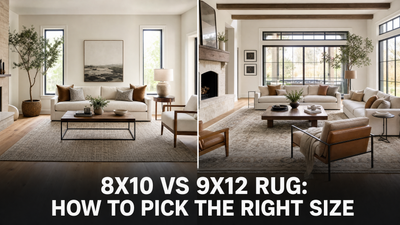
If you are between two sizes, go bigger. A rug that is too small is the most common placement problem, and it cannot be fixed with styling. For the full sizing chart by room dimensions, see our living room rug size guide. If you already own an 8x10, our 8x10 living room layout guide shows the exact arrangements that work with it, and 8x10 vs 9x12 helps if you are deciding between the two.
How to Place a Rug With a Sectional Sofa
With an L-shaped sectional, tuck the rug under the front legs of both arms of the L, so the rug corner sits just inside the corner of the sofa. At least one-third of the sectional's depth should be on the rug. The rug does not need to reach the far end of the chaise, but it should extend past the end of the longer side the same 6 to 8 inches you would give a regular sofa.
- Front legs on: 9x12 for most sectionals; an 8x10 only for compact apartment sectionals under about 100 inches on the long side.
- All legs on: 10x14 or larger.
- Open side: if the sectional faces a TV or fireplace, leave a clear 30- to 36-inch walkway along the open side instead of letting the rug edge sit in the traffic path.
Our guide to rugs for sectional sofas covers U-shaped and modular sectionals too.

Which Way Should a Rug Go? Orientation by Room Shape
In almost every living room, the long side of the rug runs parallel to the sofa. That usually means parallel to the longest wall, because that is where most sofas go. A rug turned perpendicular to the sofa leaves the arms hanging off the ends and makes the seating area feel cramped.
Rectangular vs Square Living Rooms
In a rectangular room, follow the room: sofa and rug both run along the long axis, which keeps the walkways at the ends of the room open. In a square room, a square rug (8x8, 10x10) or a large round rug often fits the space better than a rectangle, especially with a seating group arranged on four sides. If you use a rectangle, let the sofa decide the direction.
What About Patterns and Round Rugs?
Center a medallion on the coffee table, not the room. Stripes that run away from the sofa make a shallow room look deeper, while stripes that run parallel to it make a narrow room look wider. A round rug suits curved sofas, circular coffee tables and square rooms; size it so that the front legs of every seat still touch it, which usually means an 8-foot round or larger.
Rug Placement Around Walkways, Doors and Focal Points
Plan the traffic path before you place the rug. A main walkway needs 30 to 36 inches of clear width, and it should run either completely across the rug or completely beside it. A path that follows the rug edge means one foot on the rug and one on the floor, which is where people trip. Near doors, check the swing: a pile over about 1/2 inch can catch the bottom of an interior door, so choose a low-pile or flatweave rug there or keep the rug out of the swing arc.
A fireplace, TV wall or large window is the room's focal point. Arrange the seating to face it first, then center the rug on that seating. Line up the rug's center with the focal point only when the seating is centered on it too.
Rug Placement in Small Living Rooms and Apartments
Small rooms tempt people toward small rugs, but a single larger rug usually makes a small room look bigger. It reduces the number of visible edges and leaves an even, calm border of floor. In a room around 10x12 feet, use a 6x9 with the front-legs layout, or a 5x8 if the sofa is 72 inches or less. Don't go smaller than 5x8 under the main seating; a 4x6 reads as a doormat. Pick lighter, low-contrast colors and a low pile, and run the rug along the longest wall. Our 5x8 rug size guide shows how much room that size really covers.
Rug Placement in Open-Plan Living Rooms
In an open-plan space, the rug is the wall. It tells you where the living room ends and the dining room or kitchen begins. Use the all-legs or front-legs layout so the seating group clearly belongs to its rug. Line up the back of the sofa with the rug's back edge, or keep it within a few inches, to create a crisp boundary. Keep 24 to 36 inches of bare floor between the living-room rug and the dining rug, and run both rugs in the same direction. The rugs do not have to match; repeat one color or keep the same level of pattern so the zones feel related.

How to Layer Rugs in a Living Room
Layering fixes two common problems: a favorite rug that is too small, and a room that needs texture. Start with a large, flat, neutral base, such as a jute, sisal or flatweave 9x12 or 8x10, placed with the front-legs or all-legs rule. Then add a smaller patterned or vintage rug on top, usually a 5x8 or 6x9 centered under the coffee table or angled slightly. The top rug should cover roughly a third to half of the base and leave at least 12 to 18 inches of the base showing on every side. Keep both piles low so the edges don't create a trip ridge. See how to layer rugs for combinations that work.
How to Test a Rug Placement Before You Buy
- Measure the room and note doors, vents and the main walkway.
- Measure the sofa length and the width of the whole seating group, including chairs and end tables.
- Pick a layout, then add 12 to 16 inches to the sofa length and 6 inches behind the front legs to get the minimum rug size.
- Mark the rug outline on the floor with painter's tape and live with it for a day or two.
- Check the border: you should see 12 to 18 inches of floor at the walls and a clear walkway.
Common Rug Placement Mistakes (and How to Fix Them)
| Mistake | Why it looks wrong | Fix |
|---|---|---|
| Rug too small for the seating | Furniture floats around a "postage stamp" | Size up so every seat touches the rug, or layer over a larger base |
| Rug shorter than the sofa | Sofa arms hang past the rug ends | Rug length = sofa + 12 to 16 inches |
| Rug centered in the room, not on the seating | Sofa sits half on, half off | Center the rug on the furniture group |
| Rug turned perpendicular to the sofa | Seating feels squeezed | Run the long side parallel to the sofa |
| Only the sofa touches the rug | Chairs look like outsiders | Put the front legs of every chair on the rug |
| Rug edge in the walkway | Trip hazard, curled corners | Keep paths fully on or off the rug; use a pad |
| Thin strip of floor at the walls | Looks like ill-fitting carpet | Leave 12 to 18 inches, or at least 8 in small rooms |
Frequently Asked Questions
Should all furniture legs be on the rug?
How far should a rug extend past the sofa?
Which way should a rug go in a living room?
Should a rug be centered in the room or under the furniture?
What size rug do I need for a sectional?
Can you layer two rugs in a living room?
About RugKnots
RugKnots is a family-owned rug company in Hagerstown, Maryland, importing and selling hand-knotted rugs since 1987. We hand-inspect every order, offer free U.S. shipping and a 30-day return guarantee. Questions? Reach out and a real person will reply within one business day.